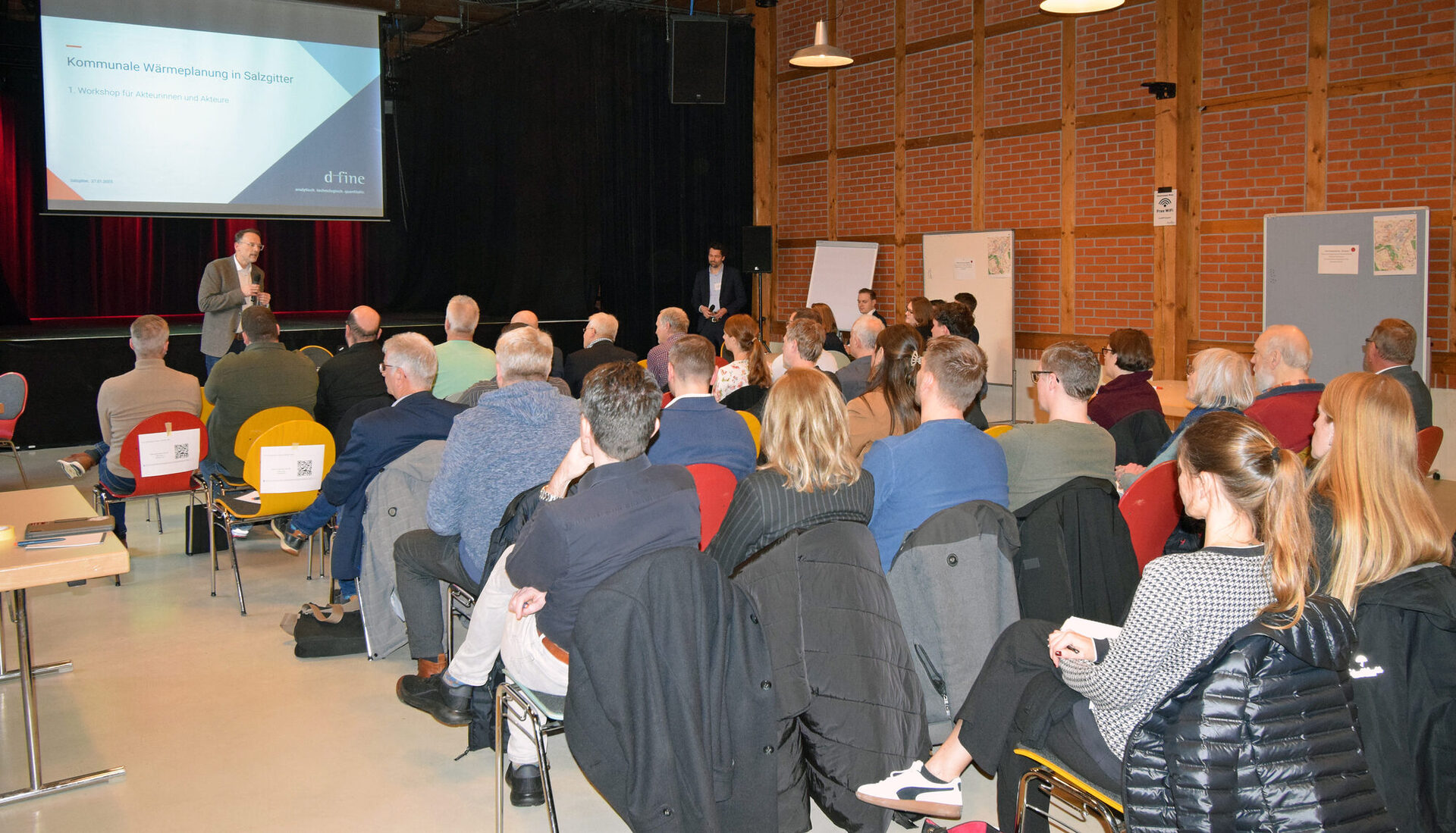
A lot of data is needed for this. In an initial workshop on January 27, 2025, local stakeholders were informed and asked to participate.
City planning officer Michael Tacke welcomed representatives of the political bodies and stakeholders who had been invited to participate in the municipal heat planning and whose cooperation was needed.
"Together with you and the citizens of Salzgitter, we want to get municipal heating planning off the ground," emphasized Michael Tacke.
The aim is to use this municipal heat planning to ensure an economical, reliable and sustainable heat supply for Salzgitter that is independent of fossil fuels.
The way: An inventory of the buildings, the heat demand, the current and future heat supply.
Important: Solutions in and for the heat supply in Salzgitter are to be developed jointly.
To this end, the city of Salzgitter and its climate protection team are working together with the planning office d-fine GmbH.
Project manager Dr. Robert Beestermöller and his team explained the process of municipal heat planning over the next few months:
1. inventory analysis, 2. potential analysis, 3. target scenario and implementation strategy:
What can the heat supply in Salzgitter look like in the years 2030, 2035 and 2040?
What measures are required to achieve this?
Comprehensive data collection is required to answer these questions.
For the first municipal heat planning, the planning office d-fine GmbH therefore needs the cooperation and support of local stakeholders, interest groups and citizens in the form of data, information and suggestions.
In cooperation with the climate protection management of the city of Salzgitter, the planning office d-fine GmbH will continue to compile and evaluate this data.
Preliminary initial results of the inventory analysis:
84 percent of heating systems are based on natural gas. In Salzgitter, industry has the highest heating requirements.
The advantage: a lot of waste heat is generated, which can be used and expanded.
The existing heating network in Lebenstedt lends itself to expansion and is already being expanded in part. Salzgitter-Bad, Thiede and Gebhardshagen are fundamentally suitable for network heating. The prerequisite is the development and new construction of appropriate pipelines.
The analysis of this potential is a central component of municipal heating planning in Salzgitter.
City planning officer Michael Tacke emphasized that after this kick-off, further talks would be held with all stakeholders in order to present the municipal heating plan with various measures to the local councils and the council. Support and cooperation are an important prerequisite, for which he expressed his thanks.
After all, the municipal heating plan is important for the city of Salzgitter and its citizens as a basis for decisions on future investments in heating supply and renovations.
Information: What happens next?
The data will continue to be collected and evaluated over the next few months.
The first draft of the municipal heat planning will be presented to the local councils by the end of the third quarter of 2025.
In addition, the final report will be presented to the city council and will then be publicly accessible.
Anyone with questions in advance can contact the City of Salzgitter's climate protection management team: