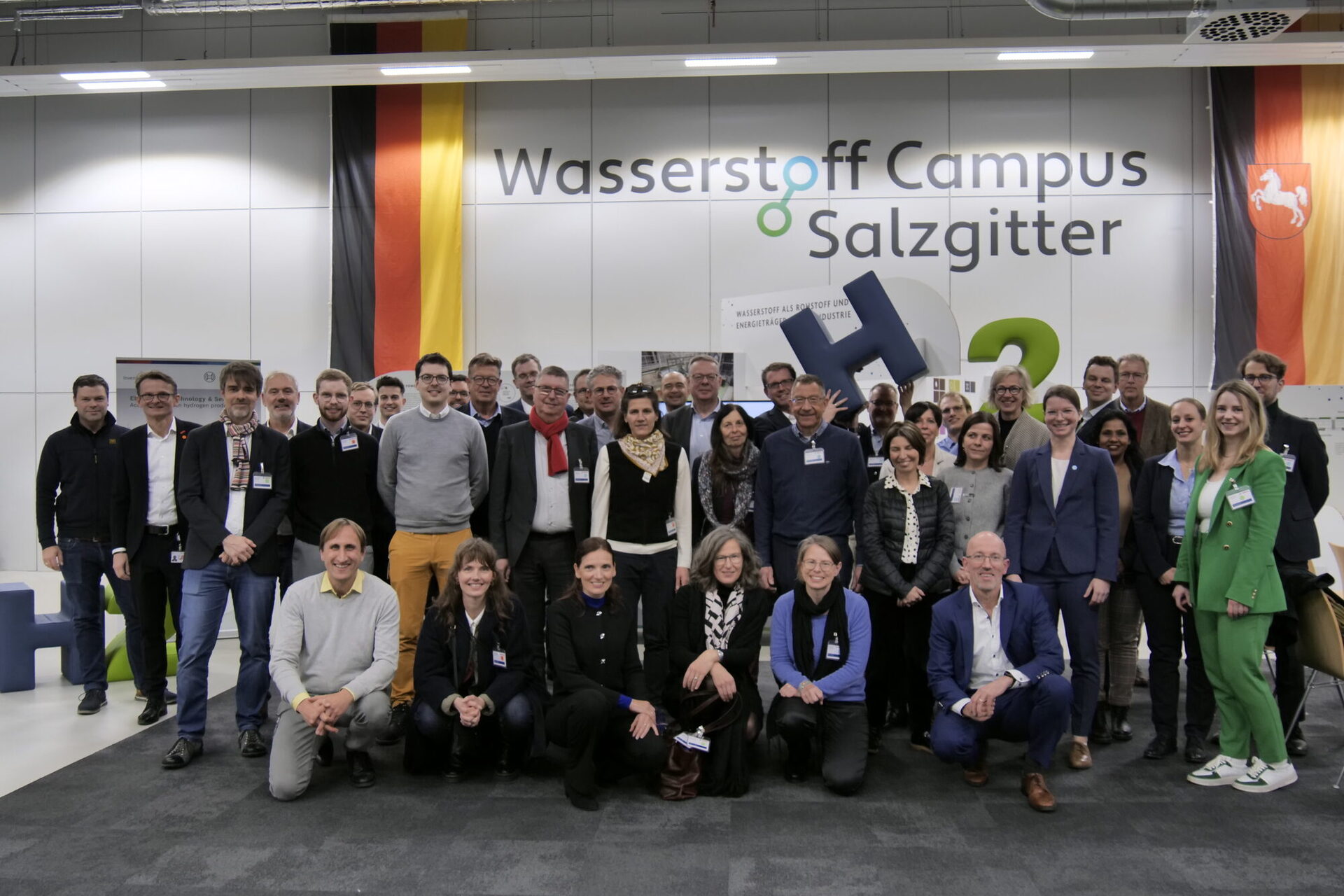
The National Hydrogen Council, consisting of 23 high-ranking experts from business, science and civil society, was appointed by the German government in June 2020 and acts as an independent, non-partisan advisory body. The visit provided an opportunity to present the activities, expertise and innovative strength of the Campus at a national level.
After an official welcome by Michael Gensicke, board member of Wasserstoff Campus Salzgitter e. V., and Jan Erik Bohling, head of the economic affairs department as representative of the city of Salzgitter, the guests were given an overview of the activities, research work and latest developments in hydrogen technology at Wasserstoff Campus Salzgitter. As a flagship project for the region, the campus is an important building block for the energy transition in Germany.
The delegation was able to gain an impression of modern production and testing infrastructures. They visited the automated stack (dis)assembly line of the Fraunhofer Institute for Surface Engineering and Thin Films IST, which is used as part of various research projects at TU Braunschweig and the Fraunhofer IST. The system is mainly used to research innovative production methods for PEM fuel cell stacks and PEM electrolysis stacks. It enables flexible dismantling of the stacks and supports the testing of industrial automation processes to increase efficiency.
As part of the Hydrogen Campus, Robert Bosch Elektronik GmbH demonstrated which technologies and strategic approaches support the factory transformation. In 2024, for example, around 30 percent of the company's own electricity requirements were already covered by the 40,000 square meter photovoltaic system, which has been fully expanded since mid-2023. In addition, the site uses regional district heating from the Salzgitter AG steelworks and relies on various energy storage solutions such as cold storage and battery storage from recycled electric vehicle batteries.
Finally, the participants experienced a VR application on electrolysis technology at Everllence and Quest One, which interactively illustrated how electrolysis systems work and made innovative approaches to hydrogen production tangible.
The visit underlined the central role of the Wasserstoff Campus Salzgitter as a location for research, development and industrial application of hydrogen technologies and promoted the exchange between science, business, politics and civil society.