

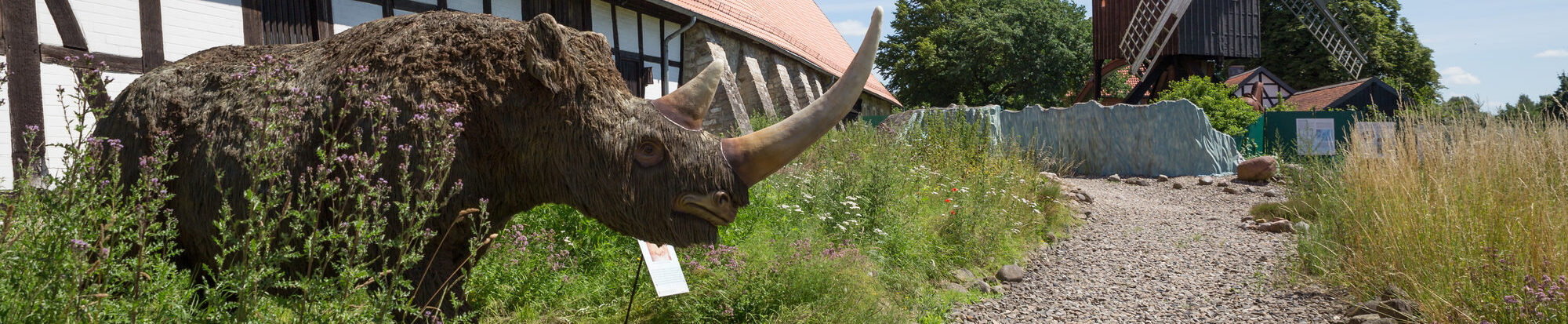

The woolly rhinoceros, whose replica will be on display next to the mammoth model already there, could reach a height of up to two meters at the shoulder and weigh three tons. Its length was around three and a half meters.
As a herbivore, the animal was dependent on the specific food supply of the cold steppe and had adapted to the climatic conditions of the Ice Age. It wore a long, shaggy coat against the cold. Its characteristic feature was the two rhinoceroses. The larger of the two could be up to one meter long and was used to ward off enemies, including when foraging.
In the future, the museum would also like to acquire the third extinct mammal identified in the "Ab der Krähenriede" find near Lebenstedt for the Eiszeitgarten: the giant deer with an antler span of over three meters and a shoulder height of two meters.
Background information: The first "Salzgitterans" lived here during the Ice Age. 50,000 years ago, they set up camp along the Krähenriede, a stream that still flows through Salzgitter today. From here, they went hunting for reindeer.
In 1952, during construction work for the pump house of a new sewage treatment plant in Lebenstedt, a layer of bones and artifacts was unexpectedly discovered at a depth of around five meters. The rich find material from archaeological excavations, which were carried out in two campaigns in 1952 and 1977, included several flint, bone and antler artifacts as well as three Neanderthal skull bones.
For a long time, the Lebenstedt Neanderthal was the northernmost evidence of this early man. Here in Salzgitter, he killed animals in order to obtain nutritious bone marrow and skins. An exhibition on the life of the Neanderthals in the Ice Age climate is planned at the Salder Castle Municipal Museum.