The situation
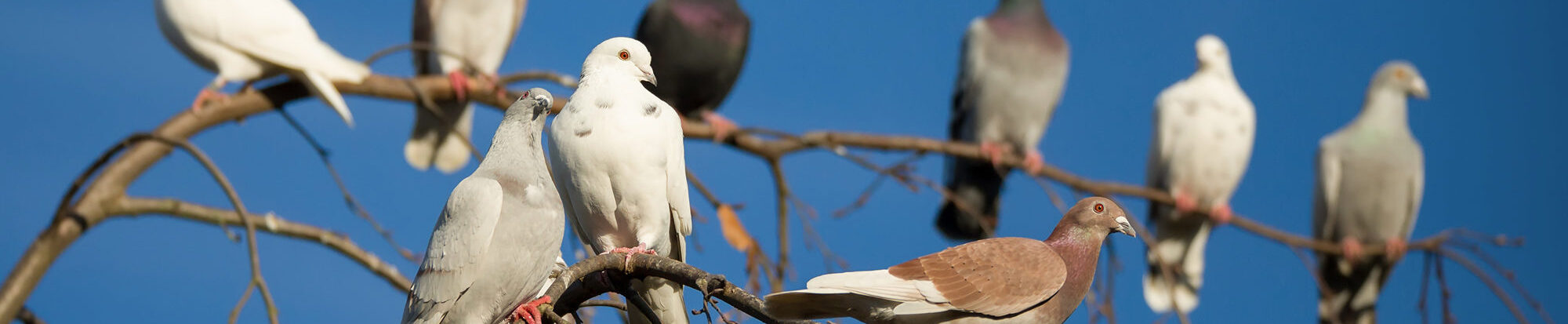
Urban pigeons are now a common sight in many cities. In the past, these animals have also settled in Salzgitter. The populations are becoming increasingly larger, which also increases the potential for conflict.
Where do urban pigeons come from?
City pigeons are largely descended from feral domestic and homing pigeons, which have been bred by humans over the centuries from the wild rock pigeon for a variety of purposes. Their population is supplemented by the influx of lost homing and racing pigeons and their own offspring.
So-called wedding pigeons also run wild in city centers, as these animals are often not homing pigeons trained to fly home.
Increased breeding activity
As a result of domestication (the process of changing wild animals into domestic or farm animals through active human intervention), urban pigeons have certain genetically determined characteristics, such as increased breeding activity throughout the year, which allows the population to grow.
The problem
People can feel annoyed by the concentrated presence of flocks of pigeons and fear the transmission of diseases.
Pigeon droppings, in this case the diarrhea-like so-called "starvation droppings", which can be traced back to malnutrition and malnourishment of the animals, cause corresponding soiling in city centers and are understandably perceived as very annoying.
Removing the droppings is associated with high financial costs.
However, the actual health risk posed by urban pigeons is no greater than that posed by other ornamental and wild birds or pets.
What does the city of Salzgitter want to do about it?
As part of its "Salzgitter - Safe and Clean 2.0" campaign, the city of Salzgitter will establish a city pigeon officer who will be responsible for expanding the city pigeon concept and implementing it in close cooperation with the association "Stark für Tiere e.V. -Taubenengel Salzgitter e.V.".
What does this concept involve?
For some time now, the employees of the "Taubenengel Salzgitter e.V." association have had an exemption from the ban on feeding pigeons imposed by the city of Salzgitter's hazard prevention ordinance.
Through these targeted feedings, the wild city pigeons could be brought together in several flocks. The purpose of this process is to later lead the animals to suitable breeding and feeding grounds (e.g. pigeon lofts).
Experience in this area has shown that the pigeons, which are characterized by an increased local fidelity, then stay predominantly in these lofts.
A first pigeon loft in the form of a converted container was recently set up on Fredenberg. This is intended to serve as a roost for the pigeons living there in the area of the shopping center and schools.
The advantage
Pigeons are by their very nature loyal animals. By providing them with species-appropriate food and water, the animals stay in the lofts for a large part of the day. This reduces the nuisance to the population by eliminating the need for long periods of foraging outside the loft, for example in pedestrian zones, in outdoor catering areas or in and around stores.
Species-appropriate feeding can prevent the so-called diarrhea-like "starvation droppings", which lead to corresponding soiling of public spaces. Up to 80 percent of the droppings are then deposited in the pigeon loft, where they are easy to dispose of.
In addition to the possibility of targeted veterinary care for sick or injured pigeons, a sustainable regulation of the population can be achieved by replacing the eggs with dummies.
The goal
The aim of these measures is to create a smaller, healthier urban pigeon population. Pigeons will increasingly stay away from hotspots and most of the pigeon droppings will be collected in the pigeon houses, keeping the city cleaner. A win-win situation for all sides.
Request to animal lovers, or why the ban on feeding pigeons must be urgently observed!
Untargeted feeding by third parties can jeopardize the success of urban pigeon management, as the pigeons may then no longer accept the targeted feeding or only accept it inadequately.
Food that is not appropriate for the species (e.g. leftover bread) lacks important nutrients for the pigeons. Such uncontrolled and irregular feeding poses great health risks for the animals.
Ultimately, such food or leftovers attract pests such as rats, which must be prevented at all costs!
Drive away pigeons
Drive away pigeons: What you must not do
Paragraph 13 of the Animal Welfare Act states the following: "It is prohibited to use devices or substances to catch, keep away or scare away vertebrates if there is a risk of avoidable pain, suffering or damage to vertebrates ..."
Birds are vertebrates, and paragraph 4 of the Animal Welfare Act states that vertebrates may only be killed by persons who have the necessary knowledge and skills to do so. Pain to the animals must be avoided.
This means that the following pigeon control measures are prohibited:
- Weapons and chemical substances
- Bird repellent paste (spreads on the claws and when grooming in the plumage and sticks it together)
- Poison wheat
- Boards with sharp nails or pigeon spikes: These measures do not comply with animal welfare regulations.
The animals can sometimes suffer serious injuries from these spikes or nails, which is why it is not justifiable under animal welfare law to use them. - Use of vinegar (damages the plumage and can make pigeons unable to fly)
- Adhesive sprays (stick the feathers together)
- Pigeon netting on the balcony (if the mesh is so large that pigeons can become entangled)
- Dummy crows and scarecrows of all kinds (light reflexes, noise, warning calls, ultrasound, magnetic pulses, lasers and odor repellents) are ineffective and in some cases contrary to animal welfare.
The following measures are approved for pigeon control
- Tension wires for pigeon repellent: Important: The wires for pigeon repellent should be installed by professionals. This ensures correct installation that protects your building against pigeon droppings and only deters pigeons, but does not harm them.
These stretched thin wires on railings, window ledges, angled rain gutters and other pigeon landing places have proven to be a successful pigeon repellent measure. The pigeons cannot find a foothold on them, lose their balance and have to fly off again. - Bird repellent using beveled edges: With a slope of around 45 degrees and a smooth surface, pigeons cannot find a proper foothold. This prevents nesting in this area. Tables and chairs set up under this area, for example in an ice cream parlor, are thus protected from droppings from young pigeons. Stainless steel sheets are ideal for this form of pigeon repellent and can be easily attached to window sills.
- Pigeon repellent nets: If used correctly, nets can also be a very effective method.
The following applies to nets and their installation:
- The net must be easy for the birds to see, i.e. the mesh must be made of thick, close-meshed threads.
- The net must be taut. If the net hangs loose and/or is made of material that is difficult to see, such as thin nylon, the birds will not notice it. They fly into it, become entangled and, in the worst case, die there.
- The net must be anchored in the building structure for optimum tension.
- The net must be maintained and regularly inspected for defects. The net must not have openings larger than the mesh size at any point.
- The net must be maintained regularly. It must be checked at least daily for birds that may have become trapped.
__________
Thefollowing applies to all three defense measures: It is best to have them installed by specialist companies. Check the installed defense measures regularly to ensure that they are still intact. If this is no longer the case, have them repaired or reattached by a specialist company.
