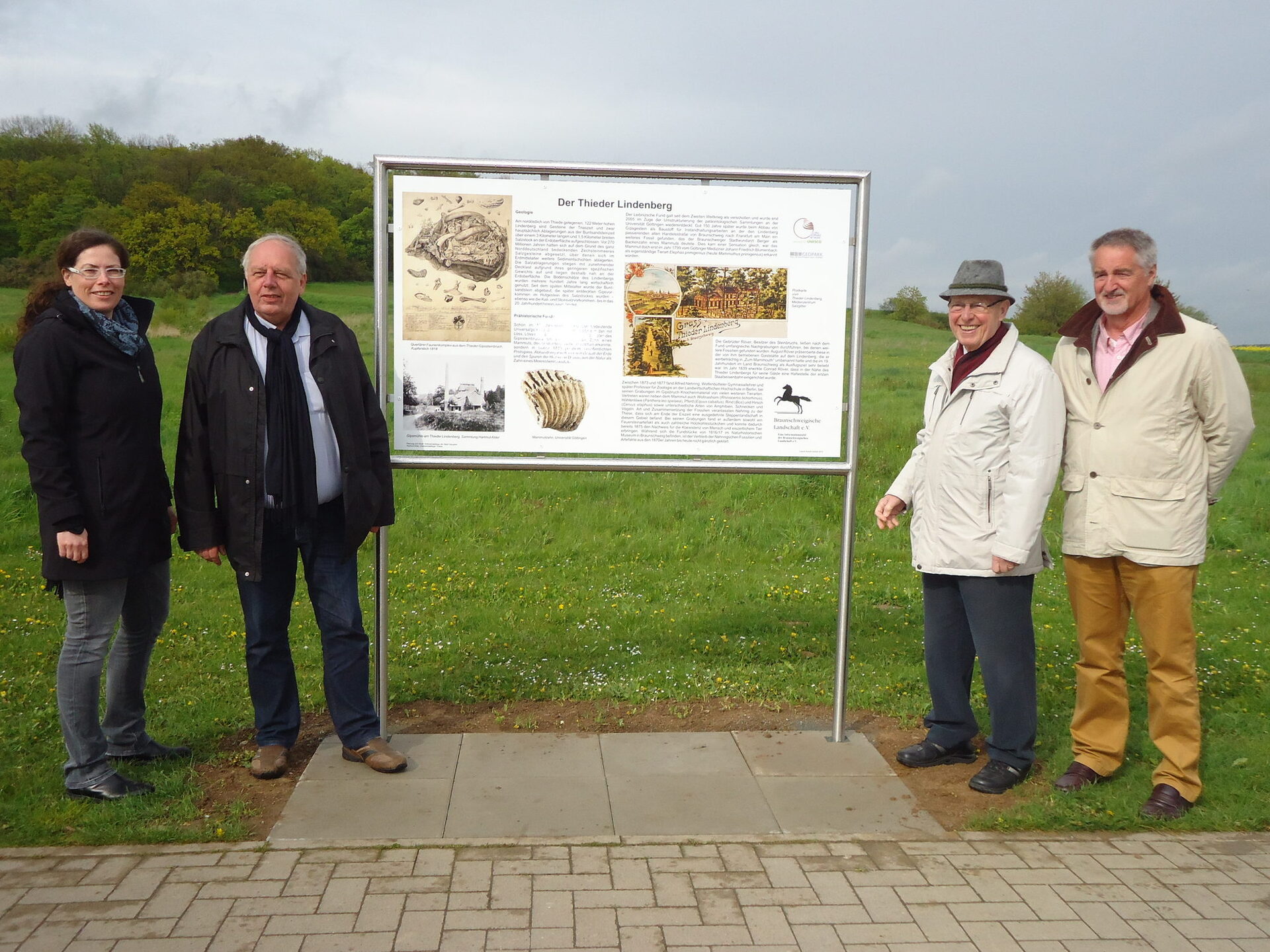
The sign, financed by the Braunschweigische Landschaft as part of an "archaeological information board" project by the association's Ortsheimatpflege working group (AG), provides information about the geology and prehistoric finds made on the 122-metre-high hill.
It was ceremoniously inaugurated by Harald Schraepler, spokesman for the working group, in the presence of many Ortsheimatpfleger from the city of Salzgitter, members of the culture committee and the Nordost local council. This was followed by a walk into the archaeological past of the Lindenberg led by Hartmut Alder (Thieder Ortsheimatpfleger).
The plaque is located on the grass verge on the connecting path between the streets An der Zwergenkuhle and Lindenbergweg. Among other things, it tells us that the mountain's mineral resources were used commercially for several hundred years. Since the late Middle Ages, this involved the mining of red sandstone, later gypsum, potash and rock salt.
In the 17th century, the important polymath Gottfried Wilhelm Leibniz was the first to find a mammoth tooth on the Lindenberg, which he interpreted as the tooth of a marine animal. A good 150 years later, another fossil was found by the Braunschweig city doctor Berger while mining gypsum rock. Between 1873 and 1877, Alfed Nehring, a grammar school teacher from Wolfenbüttel and later professor of zoology, found bone material from many other animal species such as mammoths, woolly rhinoceroses, cave lions, horses, cattle and deer during his excavations in the gypsum quarry.