1608
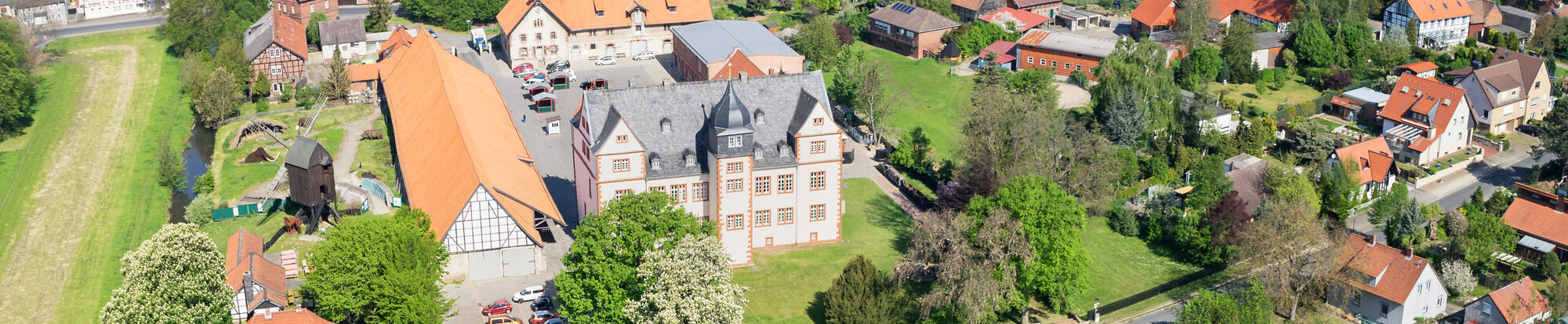
Jacob and Heinrich von Saldern pledged the ancestral seat of their family to Statius von Münchhausen due to a debt of 21,000 thalers. In the same year, he resold the property to the princely Brunswick officer, privy councillor and general commissioner David Sachse, who obtained permission to build on the grounds of the "Großer Hof" for 12,000 thalers. He had a Renaissance-style palace built - presumably by the master builder Paul Francke.
1620
David Sachse became impoverished and had to leave the country due to differences with the ducal house. The castle was bought back by the von Saldern family for 40,000 thalers following a settlement. Due to legal difficulties regarding the repurchase, Sachse's heirs filed a lawsuit, which ultimately led to a trial over ownership. This process dragged on - interrupted by the Thirty Years' War - until well into the 17th century. In the meantime, the von Saldern family had to get into debt to the von Quitzow family.
1641 - 1642
Occupation of the castle by the troops of Count Ottavio Piccolomini during the Thirty Years' War. The castle was severely devastated.
1669
Pledging of the entire Salder estate to the heirs of the von Quitzow family. Another settlement led to a brief, but only partial, repossession of the estate by the von Saldern family.
1695 - 1696
The disputes were finally ended with the sale of the "Großer Hof" and the "Kleiner Hof" in Salder to the hereditary prince August Wilhelm (Brunswick ducal family). On his behalf, the palace was converted into a summer residence in the Baroque-Rococo style by the Wolfenbüttel court architect Hermann Korb. Between 1713 and 1717, August Wilhelm had the baroque palace church of St. Mary Magdalene built. He commissioned the master builder Johann Caspar Völcker to do so.
1731
After the death of Duke August Wilhelm, the palace became the widow's residence for his third wife Elisabeth Sophie Marie. However, his successor Duke Ludwig Rudolf only granted her usufruct (right of use).
1740
Duke Karl I took away the widow's right of use in return for compensation. The estate was annexed to the ducal domains.
During the 19th and early 20th century
Salder Castle was in the hands of tenants and managers who ran the estate as a domain business.
1918
Due to the political situation after the First World War (revolution and expropriation of the German princes), the ownership structure was initially disputed. The Braunschweig state assembly decided to place the Salder estate under the administration of the state of Braunschweig.
1925
On the basis of the "Law on the Dispute between the Brunswick State and the Formerly Reigning Ducal House" of October 23, 1925, the ownership situation was settled. The Salder estate remained under state administration. It was integrated into the Braunschweig GmbH (company for the administration of state-owned land and mining property), under whose management a specialization in seed breeding took place.
1939
The Brunswick state sells the Salder estate to the "Reichswerke Hermann Göring". The castle served as the headquarters of the "Großdeutsche Umsiedlungsgesellschaft GmbH". This was responsible for the purchase and expropriation of land, for the smelting works and the mining facilities as well as for the resettlement of the local population. The resettlement company continued to exist for several years after the end of the Second World War.
1945
The castle complex was occupied by Allied troops. In the months and years that followed, several refugee families were accommodated in the castle.
1955
The successor to the Reichswerke, Salzgitter AG, handed over the castle to the town of Salzgitter for a symbolic purchase price of DM 1. City councillor Franz Zobel began to set up a museum of local history in parts of the castle.
1958
First renovation work.
1962
On December 14, the castle was inaugurated in its entirety as a museum. In the years that followed, Franz Zobel, Otto Bothe and Wolfram Forche worked as part-time directors of the museum. Dr. Heinz Kolbe was also instrumental in setting up the mining and geology departments.
1968
Cessation of agricultural operations.
1976
The museum had to be closed due to dilapidation.
1977 - 1981
Renovation, extension and conversion work carried out by the City of Salzgitter's structural engineering department while retaining the character of all the old components.
1981
The "Städtisches Museum Schloß Salder" was reopened on May 8. The museum's exhibition space was extended to 2,000 square meters. In the following years, all the outbuildings were incorporated into the museum complex.
