The invitation was aimed at stakeholders who provide professional support during the early stages of children's lives and transitions between life phases and try to make them child- and family-oriented.
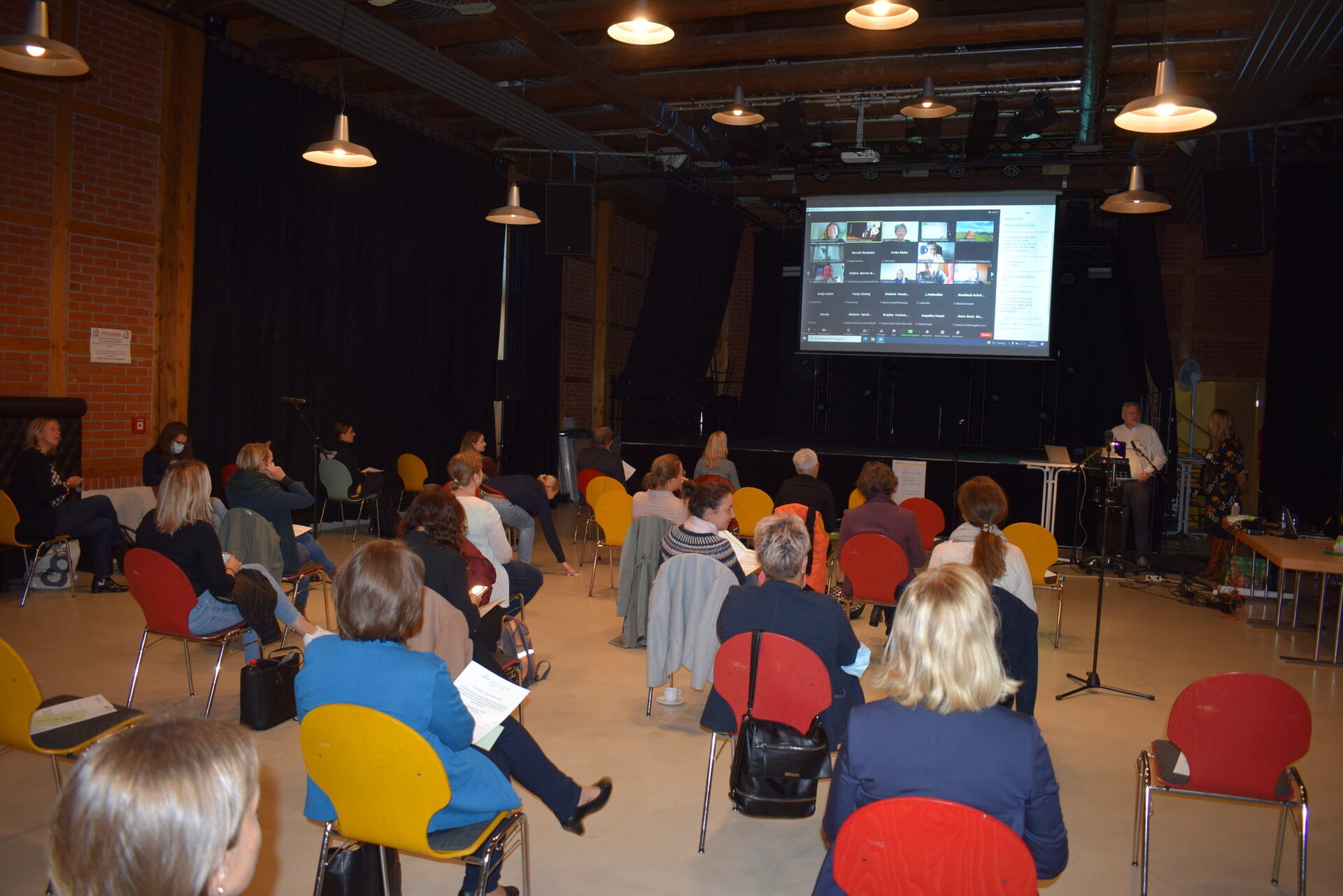
Participants were able to take part in the conference both on site and online via Zoom.
The focus of the conference and the six presentations by the five specialist speakers was on early childhood health and bonding, including from an intercultural perspective, and highlighted the impact that mindfulness around pregnancy and birth can have on children growing up healthy and thus shaping their future life path.
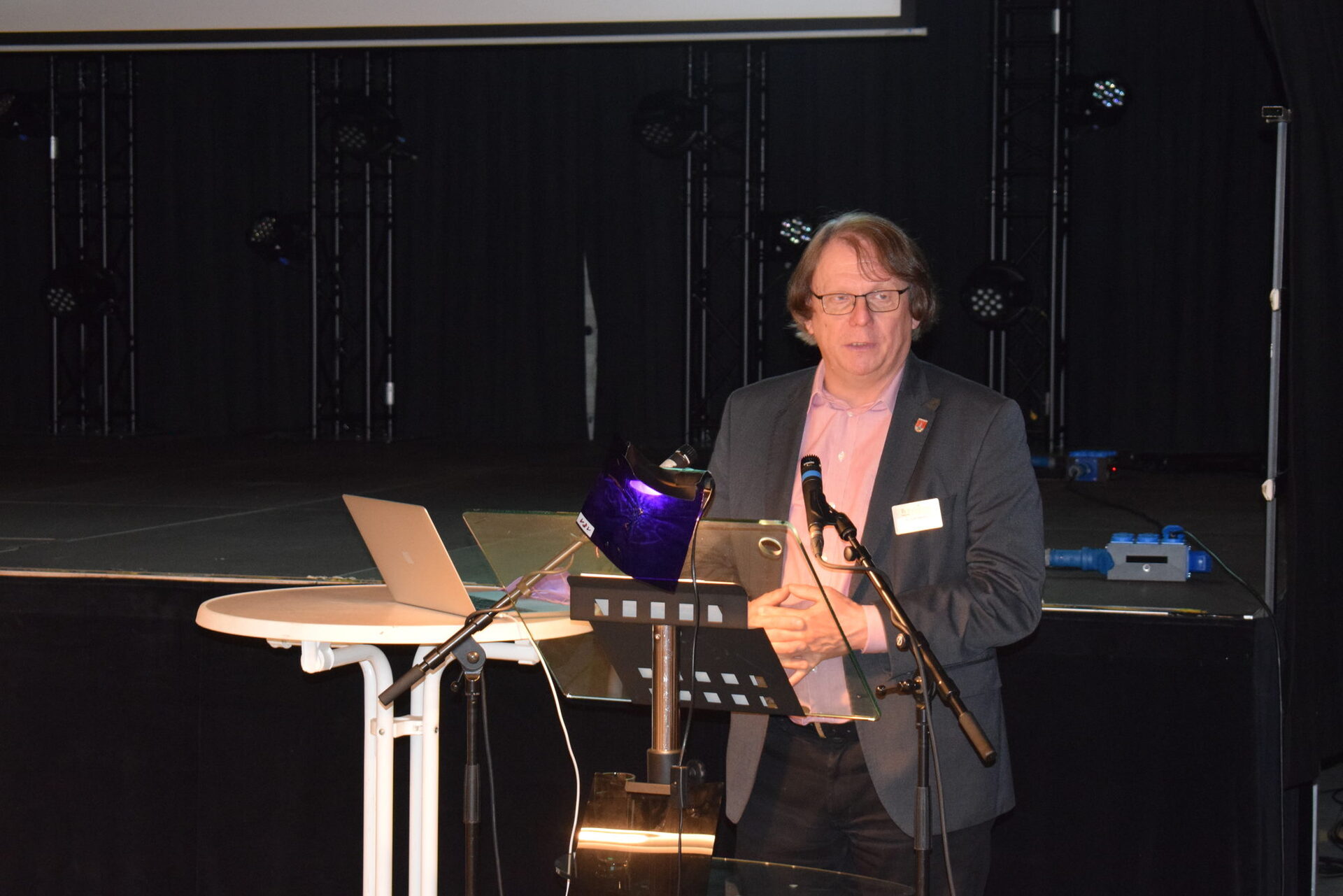
Christoph Maushake from the children, youth and family department of the city of Salzgitter welcomed the 80 or so participants in the Kulturscheune and on the screens. He remembers the birth and infancy of his son very well. He and his wife were also very unsure whether they had done everything right. They were happy to have found companions who supported them during this time. "You are the ones who are accompanying them on this journey," Maushake said to the participants. "We all want loving and responsible parents," he said, adding that this symposium was intended to help the participating professionals to help parents even better with parenting.
Dr Dirk Härdrich, head of the city's social services department, thanked the members of the Salzgitter Early Help Network for organizing this symposium. "A conference like this is important because we always need to update ourselves for our work," he explained. Information from scientists for those working in practice is important in this area in order to advance the work for children and young people.
"We want to help where help is needed," said the head of department, summarizing the work of his specialist service for children, young people and families and the Salzgitter Early Help Network, of which the specialist service is one of many member organizations. Those who work with children and young people today have to take into account the very different lifestyles of families in which children grow up.
"I hope that you return to your workplaces with lots of ideas from this symposium," said Dr. Härdrich as he opened the symposium.
Giving pregnant women more responsibility during childbirth
In her keynote speech, Ulrike Hauffe, a qualified psychologist and former State Commissioner for Women in Bremen, presented the national health goal "Health around childbirth". The Federal Ministry of Health published this health goal in 2017. It was developed between 2013 and 2016 by 30 people from science, professional associations, self-help organizations, politics and self-administration.
The special feature: The guiding principle here is a positive understanding of potential and empowerment, known as "salutogenesis". In contrast to other practices in the healthcare system, pregnancy is not viewed as a risk or disease-like condition.
Pregnancy and birth are events that can only be controlled to a limited extent, not like an operation following a diagnosis and treatment plan, explained Hauffe. And it cannot make sense for women to hand over responsibility for what happens to the medical system, which is happy to take over. According to the psychologist, what is needed is the reappropriation of women's original abilities - being pregnant and giving birth. She expressly emphasized: "By the way: giving birth, not giving birth. Women give birth themselves, others give birth. We are in danger of losing the word 'giving birth'." She strongly advocates using this word more again, linguistically in the sense of empowerment rather than disempowerment.
Healthy mental development from toddler age
The second keynote speech was given by Prof. Dr. phil Éva Hédervári-Heller, analytical child and adolescent psychotherapist. Under the title "Attachment as the basis of children's mental health", she described the emotional world of young children and the psychological conflicts as well as their treatment options in infancy and early childhood.
Infants are not yet able to express how they are feeling verbally. Disorders of well-being manifest themselves in the form of excessive crying, feeding and failure to thrive or sleep problems. In her presentation, Hédervári-Heller focused on the emotional world of infants and conveying a better understanding of psychological conflicts and their treatment options in infancy and early childhood.
The myth of a happy pregnancy and birth
Elli Kowert and Silvia van Geel reported in their presentation that the overloaded expectations that are projected onto pregnancy and parenthood often lead to new parents being overwhelmed. Both are regional coordinators for the city and district of Osnabrück for the federal parenting initiative "Mother Hood".
In this phase of life, families are confronted with images of a happy pregnancy and birth, sometimes with contradictory expectations. This often makes them feel insecure and anxious. In their presentation, the experts explored the question: "How can parents really be supported in this situation and what do the concepts of trust and self-determination really mean in this context?"
Mindful birth
In her lecture "Mindful birth? The importance of pregnancy and birth for the neurophysiological development of children", Marian-Louise Giffhorn addressed the fact that birth has an influence on a child's later development. The qualified social pedagogue and psychotherapist emphasized that despite encouragement and a great deal of support, there are children who cause teachers more and more concern. For example, they have difficulties with gross and fine motor skills, learning disorders, speech disorders and concentration problems. Learning is sometimes extremely slow and what has been learned is quickly forgotten.
Current research shows that the majority of developmental disorders in children can be traced back to problems that arose during pregnancy or at birth. If these reaction patterns remain, they act like a disruptive fire and not only affect the child's posture, movement and balance, but also have an impact on concentration, learning and behavior later on.
Pregnancy and birth in intercultural comparison
Islamic scholar Julia Nohn took a completely different look at pregnancy and childbirth. In her lecture, she addressed the question: "What is the situation regarding pregnancy and birth in other parts of the world?" Does a young mother want peace and quiet after giving birth or does she need attention and lots of people around her? Nohn spent several years studying, researching and working in Islamic countries. She incorporated her deep insights into the world of women and gender dynamics in Islamic societies into her presentation.
Attachment and familiarization in child daycare
Prof. Dr. phil Éva Hédervári-Heller also gave a presentation at this symposium on "Attachment and familiarization in child daycare". The transition from the family to daycare is a particular challenge for children. The new environment, unfamiliar adults and children as well as a changed daily routine usually cause stress for young children. Added to this is the hourly separation from the mother or father. According to Dr. Hédervári-Heller, this emotional stress can be reduced to a minimum if the child develops trust in a caregiver at the daycare facility and feels increasingly comfortable in the absence of their parents. The design of the settling-in situation, taking into account the child's basic need for attachment, is therefore of particular importance.
The "Berlin settling-in model", which has been used for decades, provides concrete practical guidelines on how the transition from the family to the first childcare facility such as a crèche, daycare center or daycare center can be successful for everyone involved with little or no stress.