Salzgitter’s City Planning Director, Michael Tacke, welcomed the workshop participants and summarized the project’s progress to date in order to provide them with an overview of the current status of the planning.
Roland Böttcher, the representative of the lead agency, the Greater Braunschweig Regional Association, provided a general overview of the topic of high-speed bike routes in Germany. He cautioned against comparing high-speed bike routes to highways. The focus here is not on cyclists’ speed, but on travel time. This requires high-quality bike paths. If the door-to-door travel time by bike on well-connected routes is approximately as short as by car, then the transportation transition can succeed. He supported this with various practical examples, including one from Wolfsburg.
Project Manager Thomas Pfeiffer and his team from the Braunschweig-based engineering firm BPR explained the three remaining main options and the approach used in selecting them. After more than 300 ideas, suggestions, and comments from the first round of public participation were submitted to the planners in the spring of 2025, the planning firm had been evaluating the route proposals received since the fall. In doing so, they faced the challenge of reviewing the large number of proposals received—which far exceeded expectations—and evaluating them in a comprehensible and transparent planning and selection process based on criteria such as environmental and transportation factors.
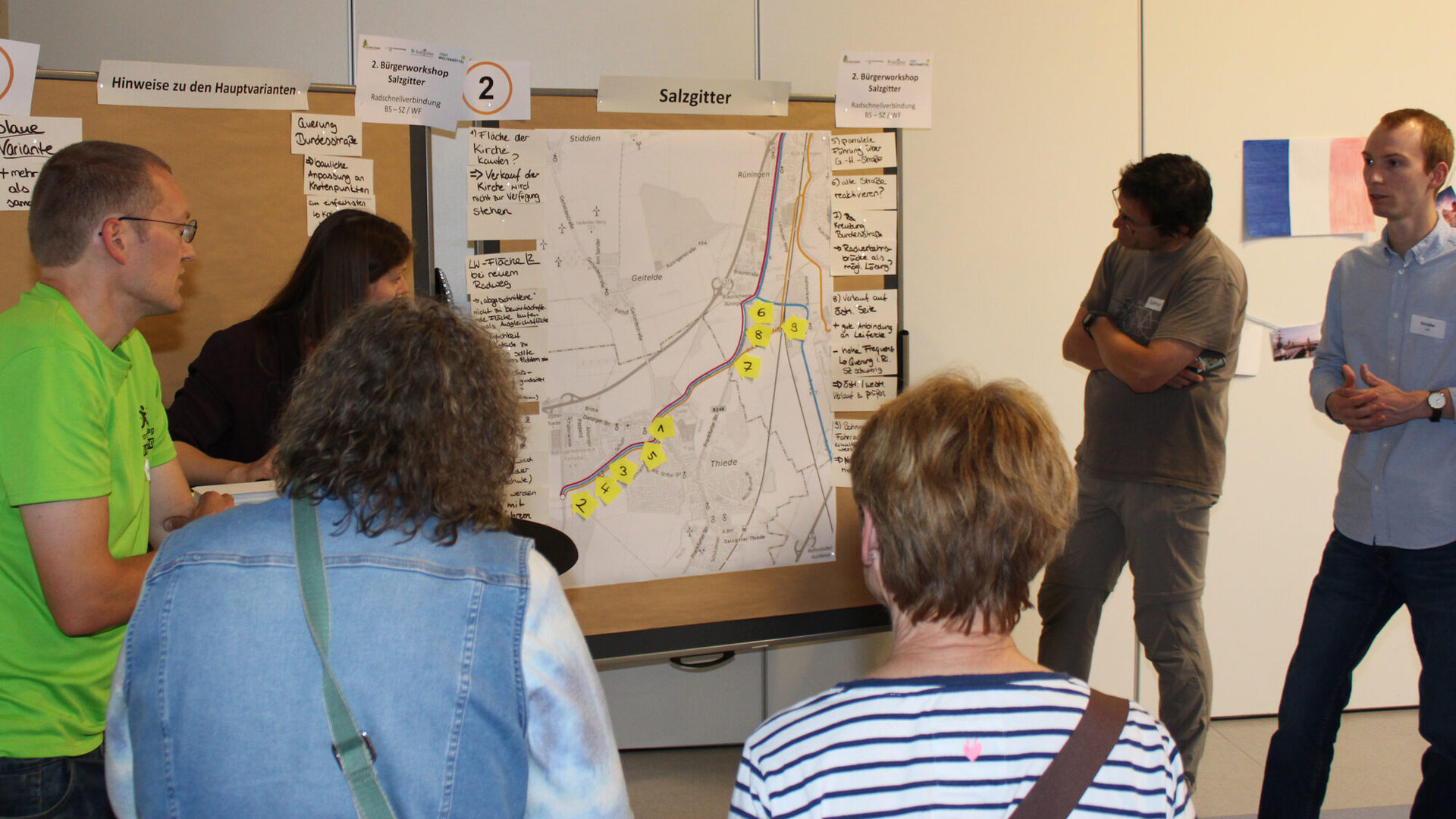
Subsequently, workshop participants discussed the main alternatives at several dialogue stations, provided input on local conditions, and collaboratively considered what a potential implementation might look like. Key points of discussion included traffic safety and intersection design, such as the crossing of the B 248 in the Friedrichshöhe area near Thiede. The goal of the workshop was to work with residents to prepare for the selection of the preferred option.
Sebastian Vogt from the City of Salzgitter concluded by providing an outlook on the upcoming phase of work to develop the final preferred option. It is scheduled to be presented at a central public information meeting this winter. Afterward, the plan is to submit it to the relevant political bodies in the cities of Braunschweig, Salzgitter, and Wolfenbüttel for discussion and approval.
The public workshop in Braunschweig took place on June 23 at 6:00 p.m. at the Raabeschule High School’s Braunschweig-Stöckheim branch.
Those interested can find the documents from all workshops on the website of the Greater Braunschweig Regional Association at https://www.regionalverband-braunschweig.de/radschnellverbindung-sued (opens in a new tab)
Background:
With the assistance of the Greater Braunschweig Regional Association, the cities of Braunschweig, Salzgitter, and Wolfenbüttel are planning a bicycle express route connecting the participating municipalities of Braunschweig, Wolfenbüttel, and Salzgitter.
Bicycle express routes contribute to the transportation transition and climate protection. They reduce travel times by bicycle or e-bike to a duration that is shorter than or comparable to that of a car. To achieve this, the bike express routes are designed to avoid time lost due to stopping at traffic intersections, slow speeds caused by insufficient lane widths, poor road surfaces, and steep inclines. The first workshop in Salzgitter took place in February 2025.