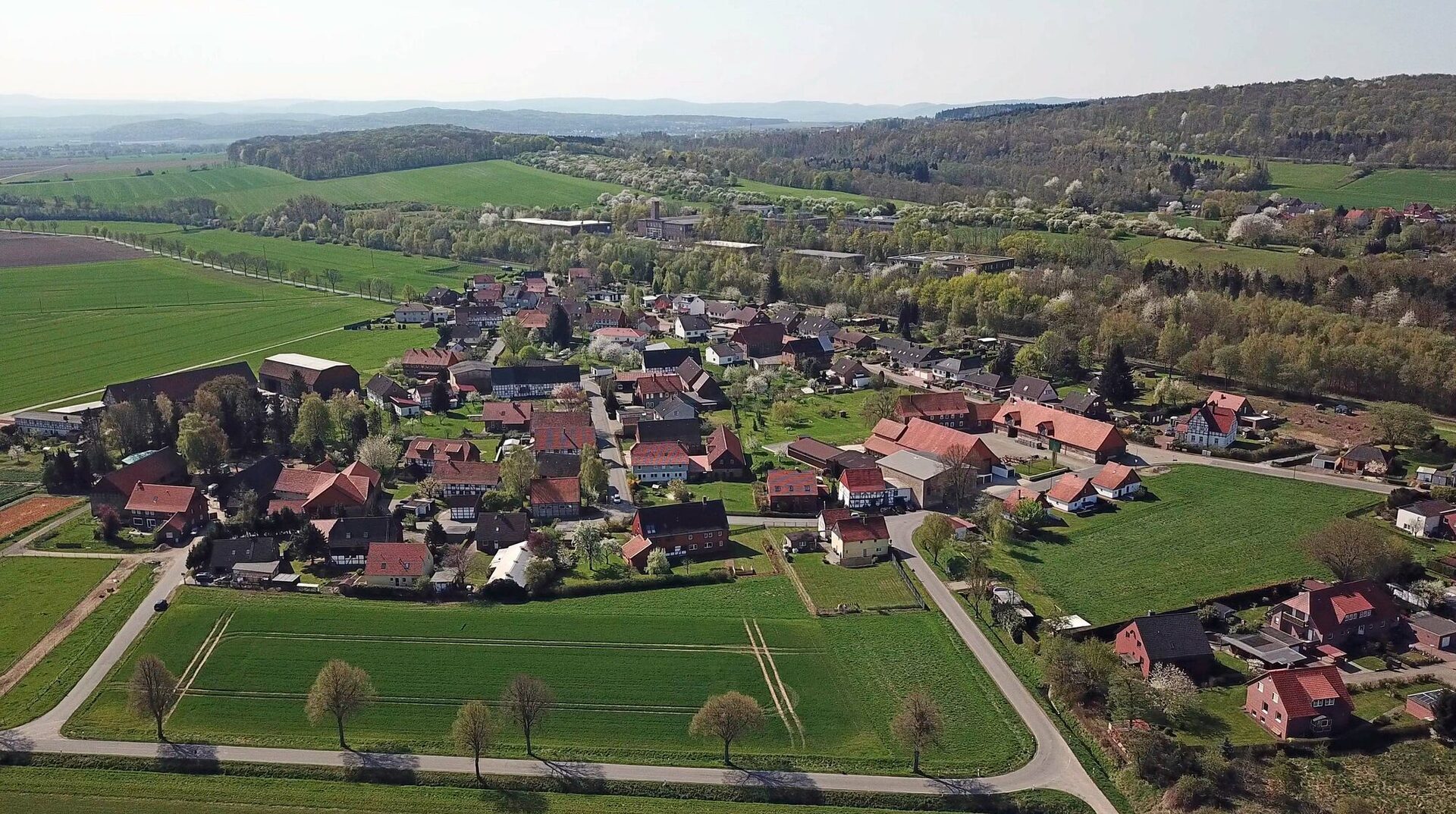
A mill acquired by Conrad von Caltbecht was one of these properties and is the first evidence of the place name of the district, which today belongs to the village of West. There is still no consensus among name researchers as to the meaning of the place name. A connection with the Middle Low German beke (brook) is considered probable. The Calbechter Bach stream and field names such as Großes Bruch and Hahne-Beeke still indicate that there was once a wet lowland area around the town, which is situated on a spur.
Calbecht, which lies on the eastern flank of the Salzgitter ridge, initially belonged to the Lichtenberg district. In 1542, the independent Amt Gebhardshagen was established, which included Calbecht, Lobmachtersen and Leinde in addition to the municipality that gave it its name. According to the poll tax description of 1678, Calbecht was not only the smallest village in the office, but also the one with the lowest poll tax revenue, with one arable farm, 14 dung farms, seven Brinksitzers and only 78 taxable persons.
From the middle of the 19th century onwards, the mining of oolitic iron ore deposited millions of years ago between Salzgitter-Bad in the south and Calbecht / Engerode in the north played an increasingly important role. The first mining fields were awarded as early as 1856/57 and were purchased by Ilseder Hütte in 1893. The latter put an ore screening plant into operation near Calbecht in 1925. In 1942 - all the ore fields and the open-cast mine had been taken over by the Reichswerke, founded in 1937 - a wet processing plant was put into operation to prepare the ore for sinter production.
Salzgittererz has been struggling with sales problems since the 1960s - ore mining and wet processing were discontinued. The former wet processing site is now an industrial estate; only the street name "Erzwäsche" (ore washing) is a reminder of its former use.
Since 1994, the former administrative building of the Hannoversche Treue II mine has been home to the Salzgitter campus of the Ostfalia University of Applied Sciences with the Faculty of Transport, Sports, Tourism and Media and its 17 degree courses.
The life of the almost 300 inhabitants of the district today is shaped by the commitment and events of the volunteer fire department, the women's aid organization and the 850 Years of Calbecht association, which was founded in 2001.
