
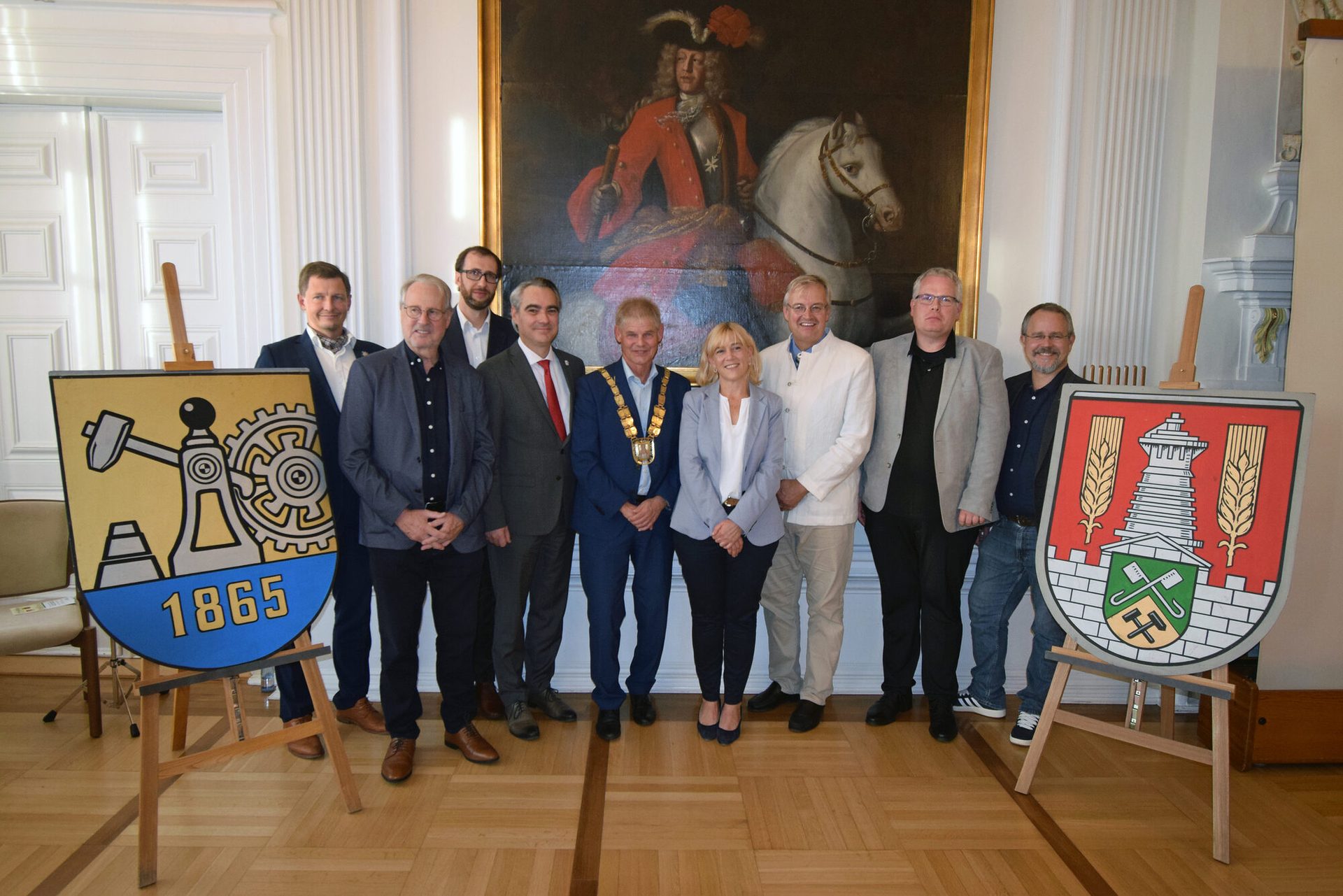
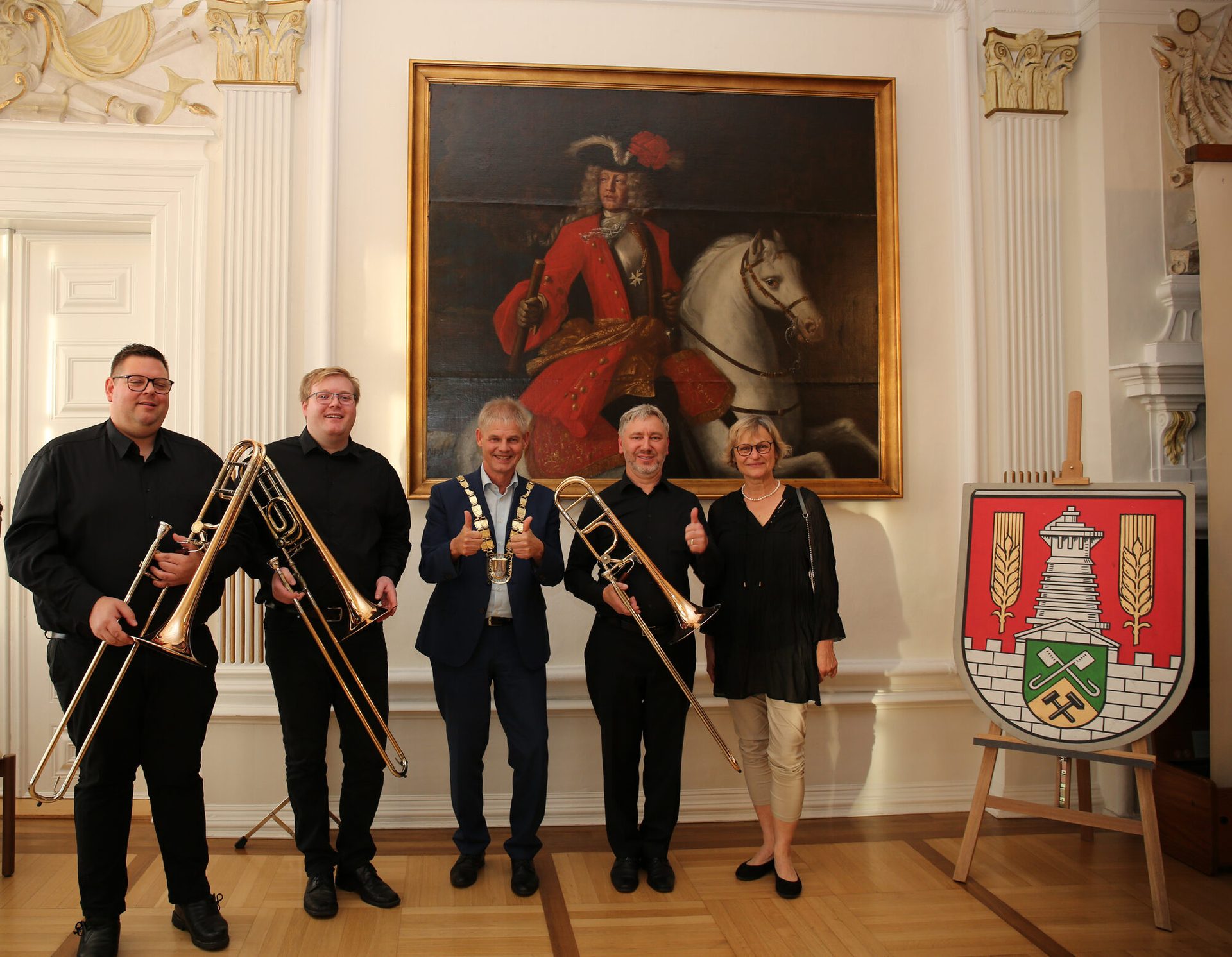
The event was held in cooperation with the City of Salzgitter and Gunter Kostorz, chairman of the Salzgitter–Katowice twinning association. As part of the ceremony, Christoph Lücke from the City of Salzgitter’s Department of Historic Preservation gave a presentation on the initial housing of refugees in refugee camps, the construction of housing developments and new churches for the mostly Catholic refugees, and the displaced persons who started their own businesses while still living in the camp barracks in Salzgitter—some of which still exist today. Lücke also highlighted the memorial sites in Salzgitter that commemorate this period, such as the Light Cross on the Bismarck Tower in Salzgitter-Bad.
Among the guests, in addition to Mayor Frank Klingebiel and Gunter Kostorz, were Sarah Krieger, representing the Lower Saxony State Commissioner for Migration and Participation, Dr. Mehrdad Payandeh; Stephan Rauhut, Federal Chairman of the Silesian Association—Lower and Upper Silesia; Heiko Schmelzle, State Chairman of the Federation of Displaced Persons, Lower Saxony State Association; Maksymilian Michalek, First Chairman of the German Alpine Club’s Katowice Section in Salzgitter; and Jacek Malcher, Secretary of this section of the German Alpine Club. Many representatives of other regional associations were also present at the ceremony, as well as a contemporary witness: Elisabeth Dierig, née Leczybil, who was born in Katowice in 1941 and came to Salzgitter in 1946, where she was initially housed in the camp in Immendorf until she found a new home in Gebhardshagen. She recalls that in 1951, she was one of three children from Katowice whose school tuition was paid by the city of Salzgitter—thanks to the sister-city agreement between Salzgitter and Katowice. She still lives in Salzgitter.
Salzgitter: A Model for a Culture of Remembrance Concerning Flight and Expulsion
In his speech, Mayor Frank Klingebiel recalled the experiences of displaced persons from Silesia, East Prussia, Pomerania, Romania, Yugoslavia, Hungary, the Soviet Union, and other regions as they settled into their new homes in the Federal Republic of Germany.
“In many places, the local population met them with skepticism, and in some cases with hostility. That was also the case in Salzgitter.” Housing was scarce at first, as were food supplies, especially in the early years. But despite traumatic wartime experiences, despite exclusion and the most adverse conditions, millions of displaced Germans took their fate into their own hands in the 1950s and 1960s. “They helped rebuild a devastated Germany and contributed to the German economic miracle as well as the economic foundation that continues to sustain our country to this day.” Today, Klingebiel emphasized, the nature of the Salzgitter–Katowice partnership has changed. “It’s about remembering the origins of the mothers and fathers who built our city. It is about commemorating their suffering during their flight and preserving the old traditions they brought with them from Silesia, and especially from Katowice.” City partnerships and sister city relationships are important for fostering democracy, he said. He concluded: “The history and culture of the former eastern territories are part of our culture. We must stand up for peace and freedom within the international community.” Since its founding, Salzgitter has been a city of immigration, he noted, one that has always distinguished itself by the openness with which its residents have welcomed those who have found a new home here.
Salzgitter serves as a model for other municipalities that no longer place the issues of flight and expulsion at the center of their historical remembrance, praised Stephan Rauhut, federal chairman of the Silesian Association.
Heiko Schmelzle, State Chairman of the Federation of Displaced Persons of Lower Saxony, called for keeping the memory alive “so that what happened between Poland and Germany back then never happens again.” He added: “How wonderful it is to live in friendship—how terrible in discord.”
Gunter Kostorz, chairman of the Salzgitter-Katowice sponsorship program, emphasized that he hoped the sponsorship with Katowice would be transformed into a city partnership with Salzgitter. Maksymilian Michalek, chairman of the Katowice section of the German Alpine Club, had already inquired with the president of the Katowice City Council. Unfortunately, Katowice already has a city partnership with Cologne, which is why this plan might prove difficult to implement.
The History of the Sponsorship
The sister city relationship has its roots in the postwar period. The initiator of the Salzgitter-Katowice sister city partnership was Helmut Kostorz, the father of Gunter Kostorz. It was the second such partnership in Germany at the time. A few days earlier, Goslar had established a sister city partnership with the formerly East German city of Brieg, now Brzeg (Poland).
Many displaced persons from the Upper Silesian city of Katowice had found a new home in Salzgitter after the war. In 1945, refugees made up 45 percent of the population. On August 15, 1951, the Salzgitter City Council unanimously decided to establish a sister city relationship with the Upper Silesian city of Katowice and its citizens. The certificate was presented on September 22, 1951.
