
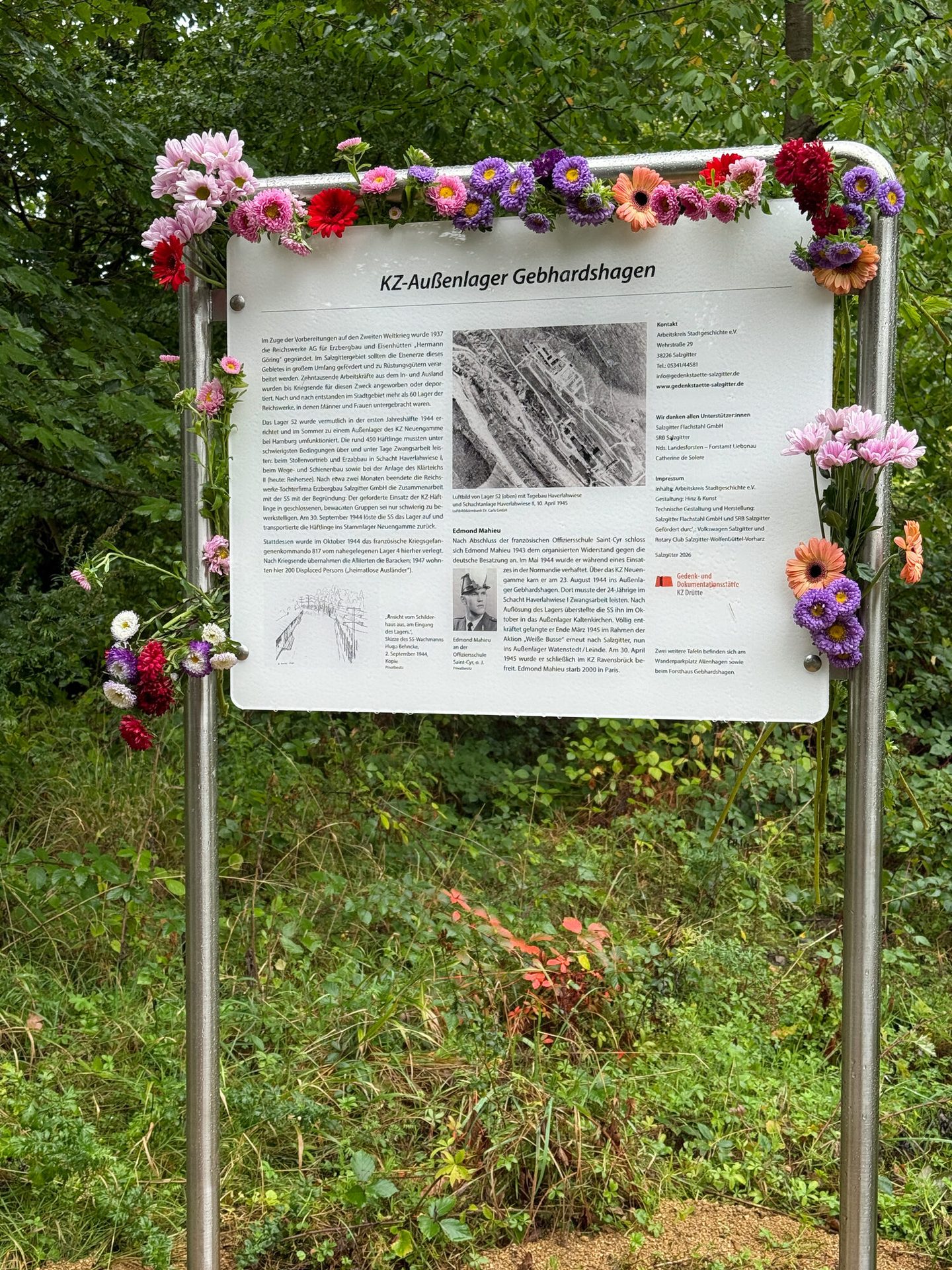
The signs are located at historic camp sites along a hiking trail approximately four kilometers long between Altenhagen and Gebhardshagen.
Jeannette Hentschel, chairwoman of the City History Working Group, emphasized the importance of the new information panels for the culture of remembrance in Salzgitter. Referring to the information panels about the former Salzgitter-Bad concentration camp that were recently stolen, she explained: “Especially now that the information panels about the Salzgitter-Bad concentration camp have been stolen, we remain committed to a vibrant culture of remembrance.”
Jens Loock, Director of Labor Relations at Salzgitter Flachstahl GmbH, also underscored the importance of remembrance work at historical sites: “It is our historical responsibility to remember the crimes of National Socialism. This is more important today than ever, as far-right extremist movements are gaining more traction in Germany.”
Frank Klingebiel, Mayor of the City of Salzgitter, highlighted the significance of the new memorial markers: “Memorial markers and information panels are now in place at all former concentration camp sites in Salzgitter. We will never be able to make amends for the crimes committed against the victims, but we can remember them and prevent this from happening again.”
Maarten Verbaarschot, the son of a former Dutch forced-laborer, “[…] wanted to tell the story of Nol and Willem, starting with their time in hiding and the raid on the church in Sevenum, their work in the mine (as far as I know), their miserable time in the camp, and how they saved each other’s lives.” The Dutchman emphasized the significance of the plaques for the relatives of forced laborers and concentration camp prisoners.
Afterward, Julia Braun from the City History Working Group led the participants from the Altenhagen hiking parking lot to the former site of the Gebhardshagen concentration camp satellite camp.
Using historical images and eyewitness accounts, she explained the history of the camp as well as the catastrophic living and working conditions of the concentration camp prisoners. She contrasted this with the biography of a guard.
Information: Forced Labor in the Ore Mining Industry
After the outbreak of World War II in 1939, numerous civilian forced laborers, prisoners of war, and concentration camp inmates were deployed at the Haverlahwiese mine, which was then part of the “Hermann Göring” Reich Works. Among other tasks, they were forced to work in ore extraction.
They were housed in five barracks camps between Altenhagen, Gebhardshagen, and Gustedt. In the summer of 1944, the SS established the Gebhardshagen satellite concentration camp in one of these camps near the Haverlahwiese II shaft. About 450 men were put to forced labor there under inhumane conditions. They had to work both above ground and underground. The camp existed for about two months.
The City History Working Group would like to thank Salzgitter Flachstahl GmbH, the Municipal Public Enterprise (SRB), and the design firm Hinz & Kunz from Braunschweig for their excellent cooperation and for making the informational panels a reality. This project was made possible by donations from Volkswagen Salzgitter and the Rotary Club of Salzgitter-Wolfenbüttel-Vorharz.