

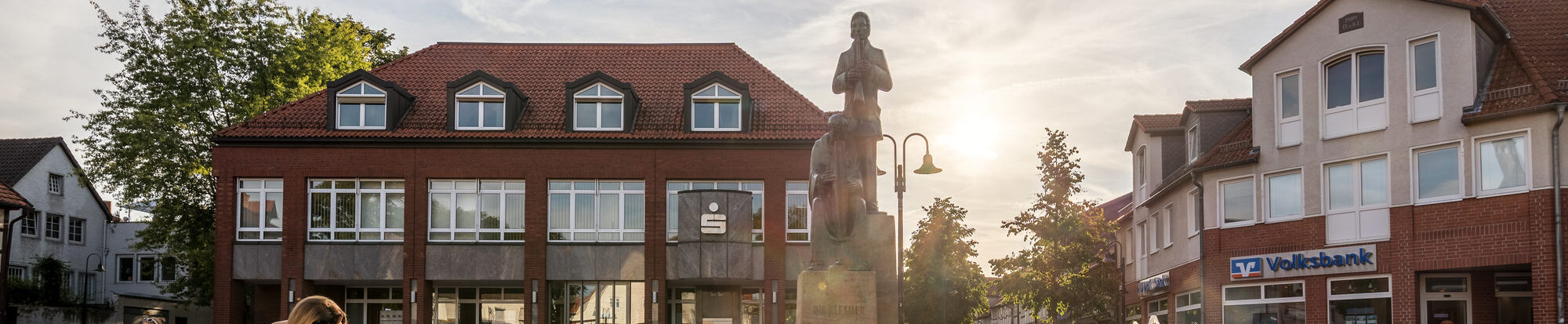

There were already a few musicians in Salzgitter-Bad before 1800 - after the Napoleonic era, the number began to rise sharply. In times of economic hardship, "Klesmern" offered a growing number of poor cottagers, day laborers and small craftsmen an opportunity to earn a living.
The first musicians joined together to form harp bands. The smallest instrumentation was harp and violin, sometimes joined by a flute or singing. In addition, brass bands were soon formed, initially quartets, and after 1820 also larger entertainment bands. The repertoire depended on the musicians' ability and level of training and ranged from local and folk songs for the smaller street bands to potpourris and overtures for the larger choirs.
The first Salzgitter musicians of the years 1790 to 1812 only toured their immediate homeland or the north-west of Germany. These journeys did not require any special funding. They were able to "klesmert" in the next town. Denmark, Norway and Sweden were also reached on foot or by covered wagon. The Dammeyer band was the first to travel to Russia in 1813. Many other bands followed them. Some played at the Tsar's court and the courts of other princes. Only the ban on music after the assassination of the Tsar in 1881 put an end to the Salzgitter choirs' concert activities in Russia.

The first overseas country that the Salzgitter musicians traveled to since 1812 was Mexico. Mostly the east coast was the destination, but there were bands that did not shy away from the dangerous ship passage around Cape Horn to perform in the west of South America. But North America and Australia were also early destinations. They even traveled to China, Japan, India, Arabia and South Africa. These overseas destinations had to be carefully planned and pre-financed. Salzgitter's merchants and above all the banker Sievers provided the musicians with clothing and the necessary travel money. As soon as surpluses had been earned, larger sums were sent to Salzgitter to pay off the debts and support those who had stayed at home.
Many of the Salzgitter musicians had their own language, the so-called Klesmer language. Expressions from Rotwelsch and Low German were mixed with foreign language elements from the countries they traveled to. It was not a full language, but primarily referred to music, travel, trade supervision, earnings, food and drink. This language was very much alive in Salzgitter until 1890, but with the disappearance of the Salzgitter Klesmer, the language also fell into oblivion. Due to the advent of "mechanical" music and the earning opportunities in industry, the number of Klesmers had become insignificant by the First World War at the latest.
Today, the annual Klesmer Festival with ensembles from all over the world takes place on the Klesmerplatz in Salzgitter-Bad in honor of Salzgitter's travelling musicians.