The inheritance registers of the Lichtenberg office, to which Hallendorf belonged in the Middle Ages and early modern period, provide an insight into the settlement structure of the village, which in 1540 consisted of five arable farms, 22 dung farms and six deserted farmsteads. A good two centuries later, the village description of Hallendorf from 1753 lists the following composition of the community: three arable farms, one half-span farm, 20 dung yards, four Brinksitzer and five cottagers.
The construction of the Reichswerke a few hundred meters east of Hallendorf brought about drastic changes for the village and its inhabitants from 1937 onwards: farmers were expropriated and resettled to Pattensen and Koldingen, among other places.
Several barrack camps were set up in the Hallendorf district for the initially recruited and later increasingly conscripted workers. A high-rise bunker was built at Windmühlenplatz and a housing estate with 276 residential units in 60 houses was built on the southern edge of the village. Centuries-old cross stones, which had presumably been erected as stones of atonement, also had to make way - they are now located in the churchyard.
In spring 1940, a "work education camp" was set up near Hallendorf, which was run by the Secret State Police and was intended to "discipline" workers. They were sent to the camp for "labor drudgery" without trial, often following a denunciation, and the conditions of imprisonment in "Camp 21" were as cruel as in the concentration camps.
Since November 2023, an erratic boulder in the forest between Hallendorf and Bleckenstedt has commemorated the more than 30,000 prisoners, at least 932 of whom died.
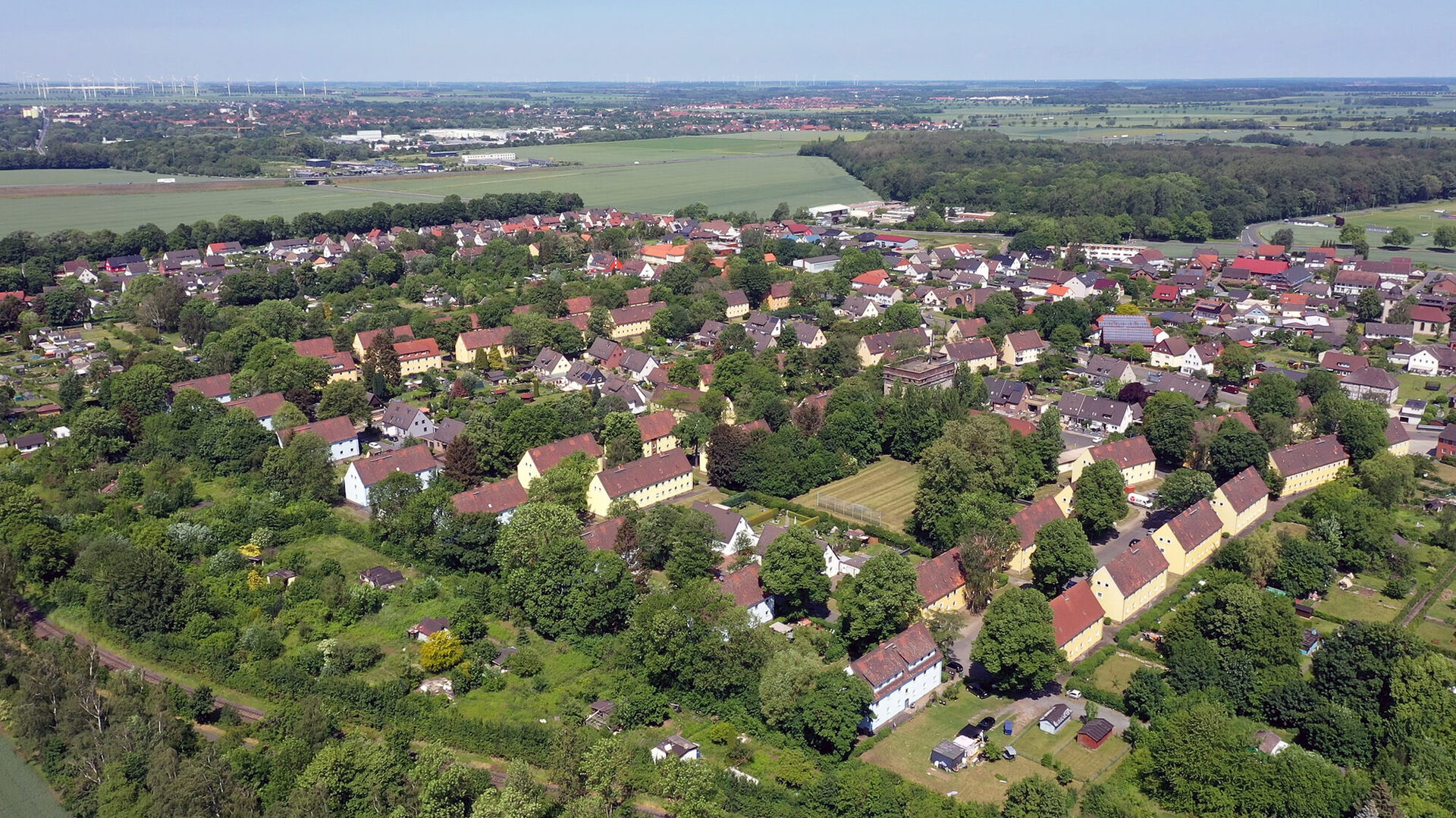
Conditions in Hallendorf remained difficult even after the end of the war. The problem of an adequate school building was so urgent that the necessary new building was financially supported by the state of Braunschweig. The new school was inaugurated in November 1950. In 1957, another housing estate was built on the western edge of the village.
Today, almost 1,800 people live in Hallendorf. The Protestant and Catholic parishes, TSV Hallendorf, the volunteer fire department, the settlers' association, the allotment garden association and many volunteers ensure that the district has a varied life and a wide range of activities.
