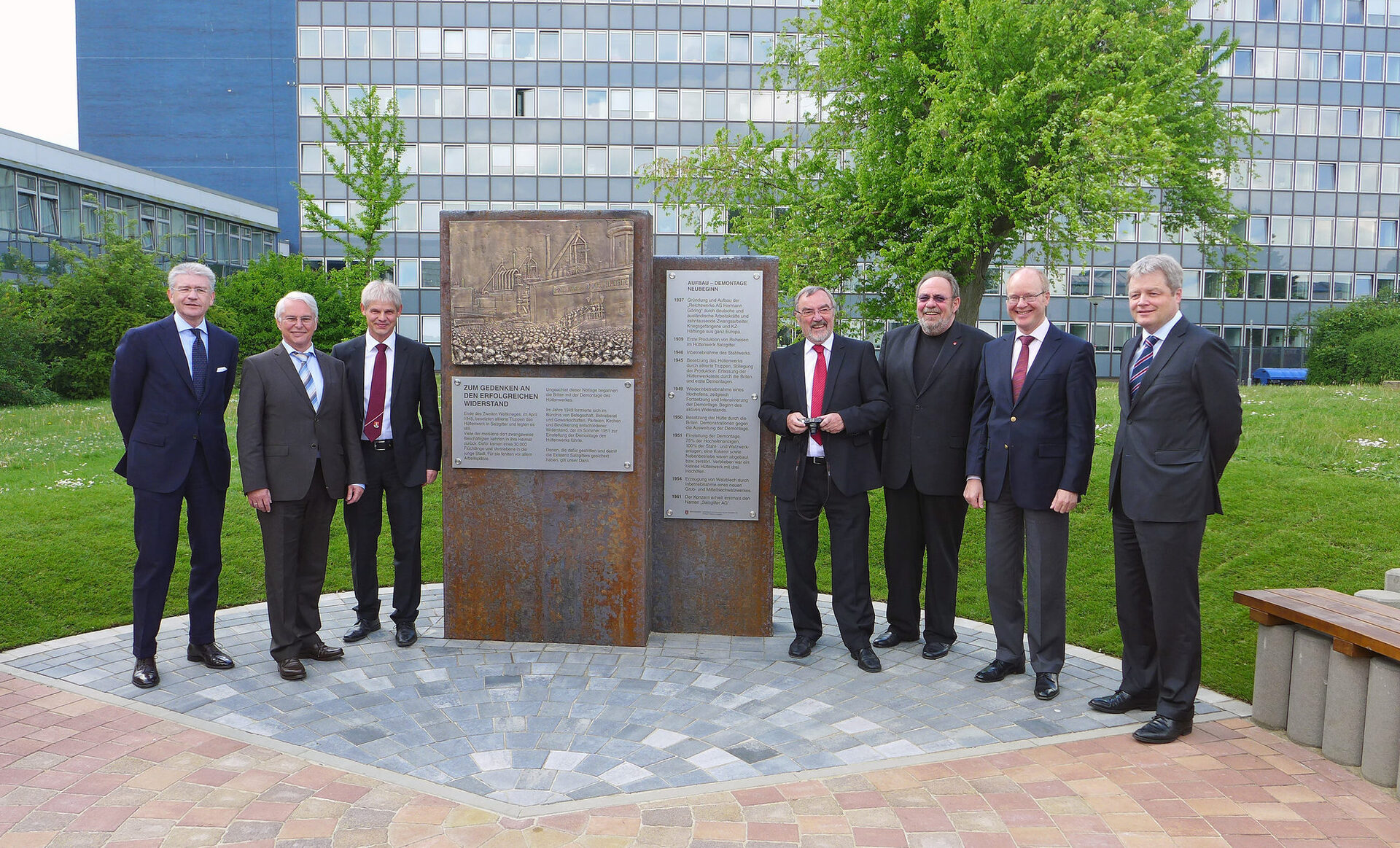
Two steel slabs pay tribute to the resolute resistance of the workforce, works council, trade unions, political parties, churches and the population against the dismantling of the industrial plants after 1945 on the basis of a decision by the Allied Reparations Commission in Brussels. The two slabs, weighing 5.5 and 6 tons, are one meter wide and around three meters high.
Lord Mayor Frank Klingebiel, the Chairman of the Executive Board of Salzgitter AG, Prof. Dr.-Ing. Heinz Jörg Fuhrmann, the 1st authorized representative of IG Metall Salzgitter-Peine, Wolfgang Räschke and the artist Helmut Lingstädt spoke at the event.
"Today we are inaugurating a special monument that commemorates the dismantling in Salzgitter. For many Salzgitter residents, this date is considered the second birth of our city. With today's unveiling, we want to visibly remember and commemorate this day," said Lord Mayor Frank Klingebiel. His thanks and recognition go to the people "who fought against the dismantling". Prof. Dr.-Ing. Fuhrmann emphasized that "the whole region, the whole city fought for this future perspective by fighting against dismantling." The monument is a "symbol of steadfastness and solidarity with Salzgitter." The monument is also a reminder to take responsibility for the region. For Wolfgang Räschke, the memorial is a "symbol of successful resistance and solidarity".
At the end of the Second World War, Allied troops occupied the steelworks in Salzgitter and shut it down. Many of the workers, most of whom were forced to work there, returned to their home countries. In return, around 30,000 refugees and displaced persons came to the young city. Above all, there was a lack of jobs for them.
Despite the emergency situation, the British began dismantling the steelworks. In 1949, closed demonstrations began, which led to the dismantling being halted in the summer of 1951. The city of Salzgitter, founded in 1942, speaks of its second, its actual hour of birth. Against the backdrop of increasing East-West confrontation and the Korean War, it was also the signal for the end of dismantling in West Germany altogether.