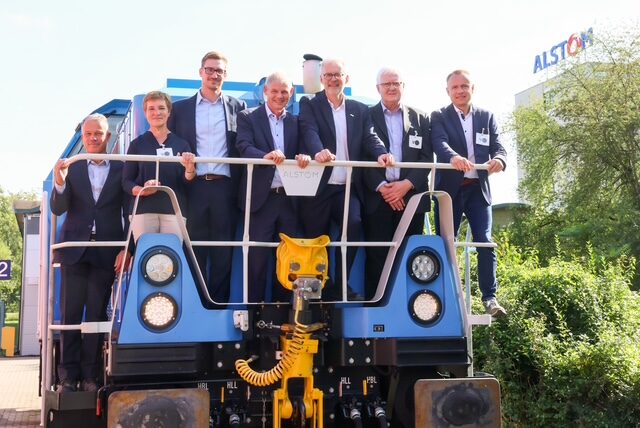
Alstom is developing the modernization solution for existing locomotives together with VPS Verkehrsbetriebe Peine-Salzgitter GmbH (VPS, subsidiary of Salzgitter AG), WTZ Roßlau gGmbH, TU Braunschweig and the associated partner Fraunhofer Institute for Surface Engineering and Thin Films. The project is supported by the city of Salzgitter, which is contributing funding of 1.5 million euros from the 50 million euros in structural aid that the city received from the state of Lower Saxony.
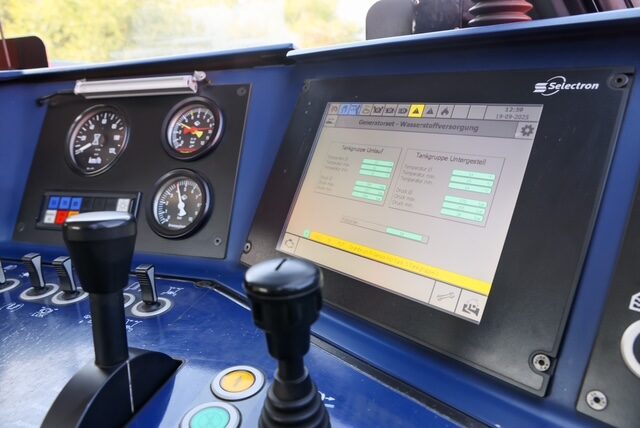
The modernization solution presented at the company's Salzgitter site is a milestone in a joint project for the decarbonization of shunting traffic. After the conversion, the vehicle engine will be powered by direct, CO2-free combustion of hydrogen. The industrial test operation, which is now beginning at the Salzgitter Group's steel-producing companies, is expected to run until October 2025. The partners expect this unique practical operation to provide important insights into the suitability of this technology for everyday use. The experience gained will be analyzed in order to investigate how it can be incorporated into a series solution. The project will be completed in the fall of 2025 and the locomotive will then be returned to its original condition.
The CO2 savings potential of converting shunting locomotives from diesel to hydrogen propulsion is huge. VPS, for example, operates 42 locomotives for the transportation of ore and coal, pig iron and steel products within the production network. There are around 1,000 diesel shunting locomotives in use in Germany and around 4,000 across Europe. The average service life of a diesel shunting locomotive is 50 to 70 years and it emits around 150 tons of CO2 per year. A modernized shunting locomotive with a hydrogen drive saves up to 3,000 tons of CO2 over a remaining service life of 15 to 20 years, which is equivalent to the emissions of up to 650 cars. You would have to plant 200,000 trees to save this amount of CO2.
Francois Muller, Head of Service Business for Central and Northern Europe at Alstom: "With this research project, we are once again pioneering the use of hydrogen in rail transportation. We are expanding the spectrum of vehicle modernization with a doubly sustainable approach - thanks to this solution, our customers can switch to emission-free operation without having to replace their existing fleet. This is a particularly worthwhile option in shunting operations due to the long service life of the vehicles."
Frank Klingebiel, Mayor of the City of Salzgitter: "Our former Minister President Stephan Weil called Salzgitter the transformation capital of Germany - and rightly so! Salzgitter AG is investing billions to switch to low-CO2 steel production by 2033 with the SALCOS project. In addition, Volkswagen is currently building its first battery cell plant here and is also investing billions in Salzgitter as a business location.
At our Hydrogen Campus, we are developing the technologies of tomorrow in the areas of factory transformation, green hydrogen and hydrogen storage. We are further expanding the district heating supply with our own Salwe project. And in the joint project to decarbonize shunting traffic, the city is not only on the sidelines, but is also an active player with a financial contribution of 1.5 million euros!"
Astrid Paus, Head of Department at the Braunschweig Regional Development Office: "Many good projects have been supported and implemented with the structural aid funds from the state of Lower Saxony. Elementary school and daycare centers were built, residential buildings were renovated and Wasserstoffcampus projects were funded. The conversion of the shunting locomotive to a hydrogen drive is one of them and is of course something very special with a world premiere. Here, the state's funding was well invested in innovation, CO2 savings and climate protection. The climate protection potential and the impact of this conversion are huge: imitation is encouraged."
Dr. Johannes Dreier, Managing Director of VPS: "This test deployment of a locomotive with an engine converted to direct hydrogen combustion fits perfectly into the ongoing transformation within the Salzgitter Group.
With the SALCOS - Salzgitter Low CO2 Steelmaking program, the Salzgitter Group will be gradually converting pig iron production from the blast furnace route to direct reduction, initially predominantly natural gas-based and later increasingly hydrogen-based, over the coming years. As the Group's central logistics service provider, we are also required to test alternative drive concepts for our locomotive fleet in order to make our contribution to the decarbonization of the Group."
Dr. Christian Reiser, Managing Director of WTZ Roßlau gGmbH: "During the intensive development work, we were able to successfully apply our expertise, especially in the field of combustion process development and system application, to the research project. As a result, the future-proof hydrogen engine technology was successfully transferred from the test bench to the real track. We are very much looking forward to the upcoming test operation of the locomotive. Because a green future is our drive!"
Prof. Dr.-Ing. Peter Eilts, Head of the Institute for Internal Combustion Engines and Fuel Cells at TU Braunschweig: "Hydrogen has the special feature that it can be burned with a high excess of air. For the conversion of the shunting locomotives, we are making targeted use of this property in order to stabilize combustion, increase efficiency and at the same time minimize the formation of nitrogen oxide. We have worked intensively on the design of the exhaust gas turbocharging, as the high excess air poses a particular challenge here. With success!"