

As it turned out, it was worthwhile for the children to really think about it. The "fuxundkauz" project, which is anchored in cultural education and funded by the Federal Agency for Civic Education, came to Salzgitter from Hamburg to spend four mornings talking, philosophizing and discussing the topic of identity with pupils from the 5th and 6th grades of secondary school.
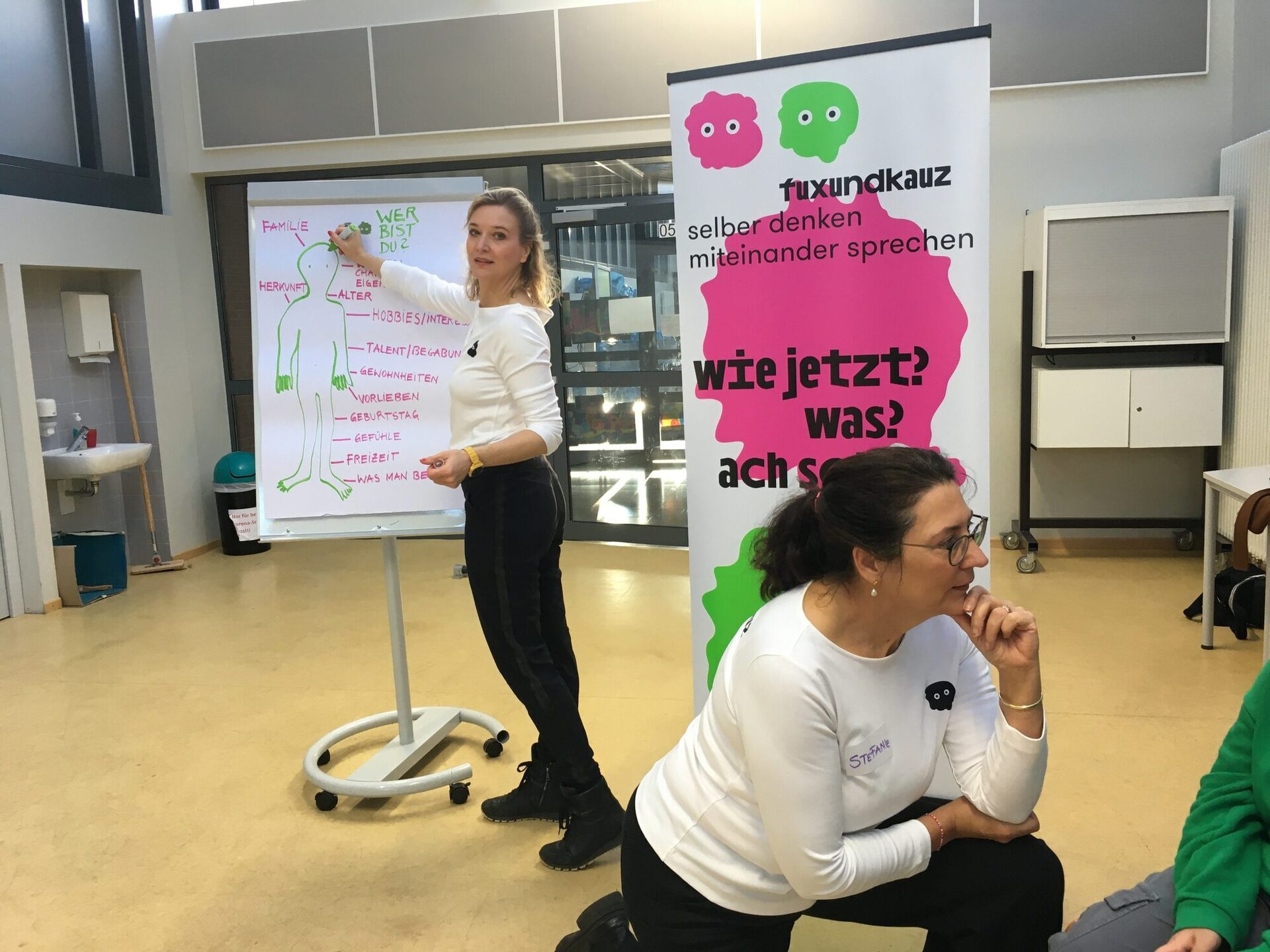
"Fuxundkauz" are the founders Miriam Holzapfel and Stefanie Segatz, who, equipped with lots of ideas, thoughts and questions, a flipchart and, last but not least, the project's own colorfully designed magazine "filofux", were very excited to see how the children would take to their "thinking workshops" and what they would develop from them.
If "philosophizing" primarily means "wanting to know a lot", adopting different perspectives and getting thinking moving, it makes sense to start in a very concrete way: This is why the children - as soon as they had settled into their seats - were asked to stand up again, walk around the room in a jumbled fashion and then sit down on a different chair than before.
"Do you remember who was sitting there before?" "fuxundkauz" then asked the pupils. They let the children take it in turns to talk about what they knew about the other person and what they thought others should know about them. The thoughts were recorded visually on the flipchart, so that it soon became clear that every person is made up of many different aspects, only a few of which are perhaps recognizable at first glance. Is Utku an only child? Is Alma good at math? Do the others also think she is "funny" and does that match their own perception? Is someone else rather shy? Do you suddenly discover that your birthday is on the same day? Does it matter what hobbies you have or what you own? Is religious affiliation important? Does Lorena have a favorite animal and can Filippas explain it well?
The two speakers were then interested in another question: "Do you think it's important to know something about each other?" they asked the group. Beforehand, each child had received three voting cards from them - "Yes", "No", "???" was written on them. Because there is not one "right" answer to every question and sometimes the only reasonable answer is "I don't know yet" or "undecided".
Nevertheless, most of the cards in this first voting round of a fifth grade class show a "yes". "Why?" asks one of the speakers and gets a very understandable answer: "We're all new here and if we want to be friends, we need to know something about each other." The fact that it can be of varying importance to individuals how much others know about them and, conversely, how much they want to know about them, and that there are things that are better shared with only a few people, can be seen from the further reflections and rounds of lightning questions.
A "result" that was easy to agree on and accepted by everyone.
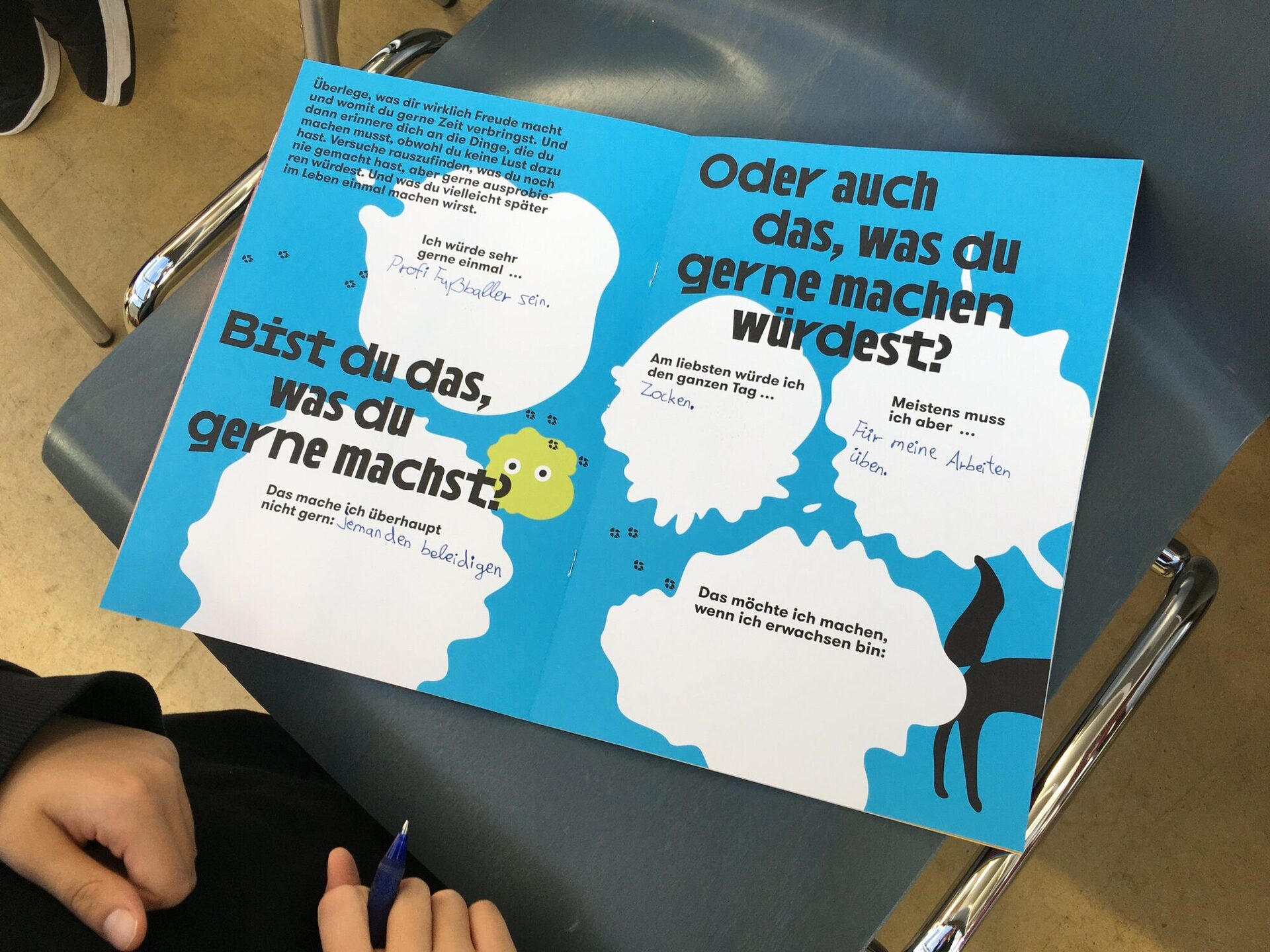
After a short break - because intensive thinking can be quite exhausting - we continued with the "filofux" magazine. More precisely, with the first issue, which deals with this big, complex concept of "identity", i.e. "what makes you the person you are" - according to your own opinion, which is not necessarily congruent with the view of others. It doesn't have to be, because just as the world is constantly changing, we ourselves are unlikely to remain exactly the same as we once were. And at least in our imagination, we can even look into the future and imagine where or how we would like to be one day.
The search for what our own "heraldic animal" might look like, for example, showed just how different and varied our own motivations, preferences, expectations and associations can be: A lion with a shining mane looked out of a booklet at the speakers, who took the time to talk to the children individually during this creative phase. This "king of the animals" then appeared even more frequently, painted here, described there. Others chose a dog or a cat simply because they like these animals so much or attribute characteristics to them that they can identify with. But one boy also chose the spider as his heraldic animal and drew it in his notebook - and he too had his thoughts on it: "It's a very small and useful animal", and therefore worth mentioning for him.
Some of the children had already turned the pages: "Are you special?" or "How are you with others?", they read on the colorfully printed following pages, for example. "Are you your environment?" or "... where you want to go?" asked "filofux" in another place. And finally, the magazine even wanted to be turned upside down, because this consideration can also be quite revealing for one's own attitude: "Do others see you the way you see yourself?"
As in the previous rounds of talks, the in-depth discussion with the magazine as a whole revealed that Finding out more and always new things about yourself can be a real adventure and important for always being able to locate yourself in a world that is subject to many processes of change. So the question will certainly not be answered by the last page of the "filofux" magazine, which is completed individually by each student - because you are by no means "at the end of your thoughts" - quite the opposite!
However, the duration of a "thinking workshop" is necessarily limited - and so after 90 minutes of asking questions, talking and philosophizing with each other, it was time for the participating classes to draw a first small summary: "How did you like the past 1 ½ hours?", the speakers wanted to know from them and listened attentively and openly to what the children found "good, but perhaps not so good". And vice versa, there was also feedback that clearly reflected the positive atmosphere of the discussions and was also expressed in the overall review of the week: for Miriam Holzapfel and Stefanie Segatz, the visit to Emil-Langen-Realschule and the exchange of ideas with the culturally diverse pupils there was also an impressive experience that they look back on fondly.
The series of events held at the Emil-Langen-Realschule Salzgitter from November 7 to 10, 2023 with the "fuxundkauz" project funded by the Federal Agency for Civic Education was organized and made possible by the Literaturbüro in the City of Salzgitter's Department of Culture.
